
A Christmas in Song: Jonathan Courant on Nostalgia, Jazz, and the Music That Brings Us Home

As Christmas settles in and the year exhales toward its close, Jonathan Karrant moves through the holiday season with a mixture of joy, reflection, and quiet introspection. For the acclaimed vocalist—whose career spans grand opera houses, intimate jazz clubs, and some of America’s most respected concert halls—Christmas is not merely a season of performances. It is a return.
“Christmas has a way of bringing us back to our beginnings,” Karrant says thoughtfully. Growing up in Fort Smith, Arkansas, in a home filled with music, dance, laughter, and constant motion, the holidays were an immersive experience—sensory, communal, and deeply emotional. “All the food my grandparents were cooking, all those smells in the house, family coming in from out of town—the house was always full. It was magical.”
That sense of fullness—of people, memories, and music—still follows him onto the stage today. Holiday songs, he explains, carry a particular emotional charge. “They’re very nostalgic. The music can take you right back to being a kid—the magic, the wonder, going to the candlelight service at church, singing those songs together.”
Yet nostalgia, for Karrant, is never uncomplicated. Alongside warmth lives melancholy. “I enjoy the holidays and really look forward to them,” he says, “but I do feel a little sadness. Christmas makes you think of loved ones who are gone but always with us. It makes you think of a time and place that can never quite be again.”
That emotional duality—joy braided with longing—is captured most clearly in Christmas Memories, his favorite track from his holiday album Christmas Wish. Written by legendary lyricists Marilyn and Alan Bergman, with music by Don Costa, the song articulates what Karrant feels each year: gratitude for what was, tenderness for what remains, and acceptance of what has changed.

Although he recently returned to Arkansas for Thanksgiving, he acknowledges that time has altered the landscape of those gatherings. “So much of the family is scattered now, and several relatives have passed away. It’s still joyful—but it’s different.” Christmas, he reflects, is both retrospective and forward-looking: a pause to honor the past while stepping toward a new year.
In American culture, Thanksgiving may be the official family holiday, but for Karrant, Christmas reigns supreme. “My favorite holidays are Christmas and New Year’s,” he says. “They carry emotion, reflection, and hope all at once.”
That emotional intelligence is precisely what has earned Karrant praise for making classic songs feel deeply personal. When approaching a Christmas standard—songs that generations have lived with—his goal is not reinvention for its own sake, but authenticity. “It starts with the arrangement,” he explains. “You tailor it to your personality, twist it just enough to make it yours without losing its originality.”
On Christmas Wish, that philosophy comes alive. “I’ve Got My Love to Keep Me Warm,” typically performed as a swing, becomes a Latin samba under Karrant’s direction. “The idea was warmth,” he says. “Samba rhythms make you think of sunshine, beaches—something warmer. I wanted to connect that feeling to the lyric.” Similarly, George Michael’s Last Christmas is slowed into a bossa nova, transforming heartbreak into something intimate, tender, and quietly hopeful.
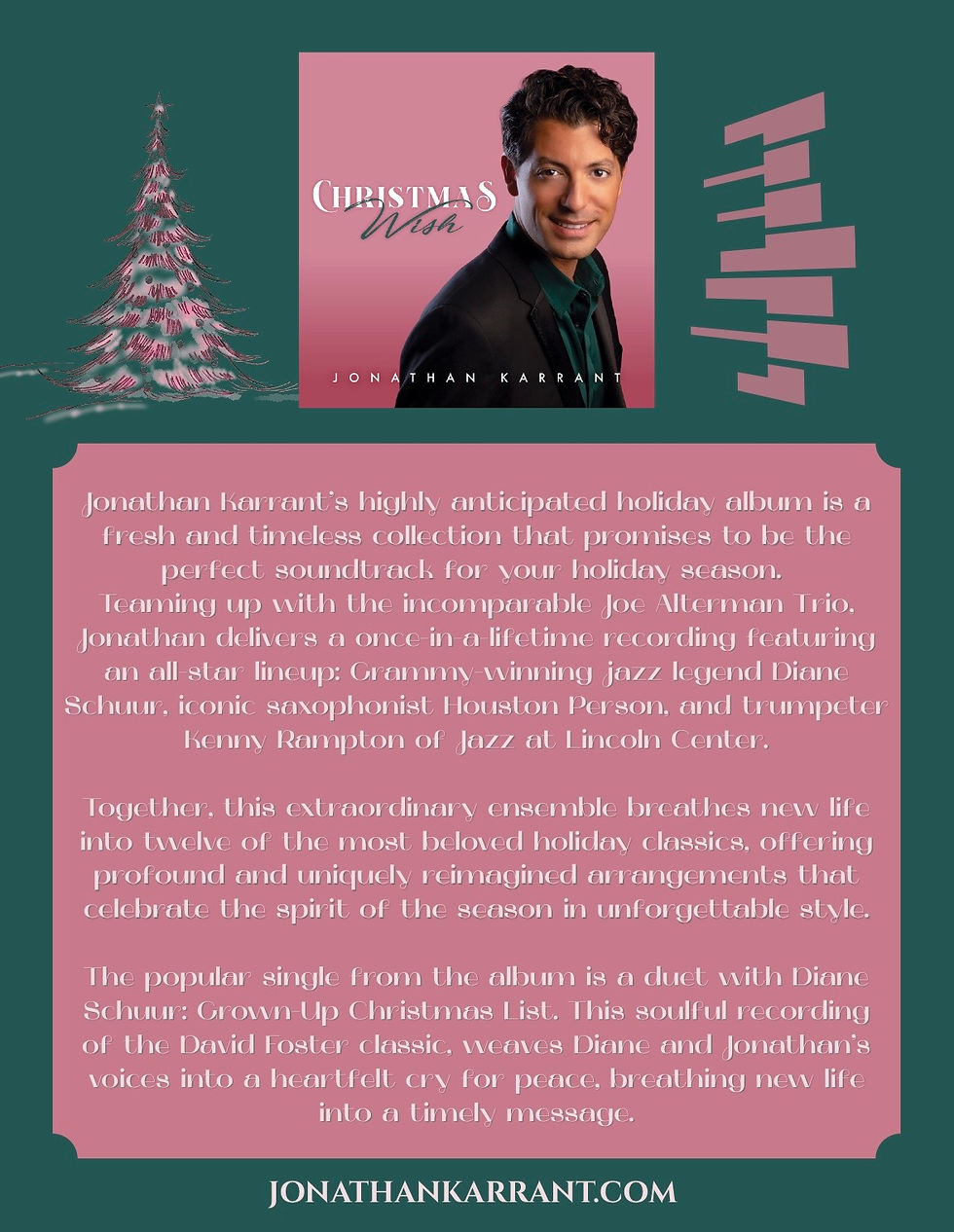
The album itself feels less like a traditional holiday compilation and more like a conversation—unhurried, personal, and sincere. At its emotional center is Grown-Up Christmas List, written by David Foster and recorded as a duet with Grammy-winning jazz legend Diane Schur. “That song really brought the whole album together,” Karrant says. “It’s not about toys or presents anymore. It’s about peace on earth.”
That message, he believes, transcends the season. “We can be young at heart, but as adults, what we’re really asking for is peace, love, and understanding—not just at Christmas, but all year long.”
While Karrant’s career has taken him from the grandeur of the Metropolitan Opera to jazz clubs and cabaret stages across the country, Las Vegas has become his home base. Myron’s at The Smith Center, in particular, holds special meaning. “It’s my musical home,” he says. “I play there regularly, and there’s a deeper personal connection. I have regulars—it feels like family.”
Designed to seat just under 300 people, Myron’s offers an intimacy rare in modern performance spaces. “There’s not a bad seat in the room,” Karrant explains. “The sound is incredible, the lighting is perfect—it really showcases the artist.” For audiences, it’s equally welcoming. “By the end of the night, you’ve probably made a friend sitting next to you.”
Earlier this December, Karrant also performed with the Las Vegas Philharmonic at Reynolds Hall, ushering in the holiday season with a large-scale celebration featuring multiple artists. “That was spectacular,” he says. “A beautiful way to begin the holidays.”
The journey between those two worlds—philharmonic grandeur and cabaret closeness—has profoundly shaped how Karrant communicates with audiences today. “Life experiences, both on and off stage, allow you to dig deeper into songs,” he reflects. “Over time, you become more comfortable, more yourself. You learn to tell the truth.”
Collaboration has been a constant throughout his career, from Diane Schur to Joe Alterman and numerous composers, arrangers, and musicians. The holiday season, he notes, brings its own collaborative energy. “Holiday music brings out people who may not usually go to live performances,” he says. “These songs are part of people’s lives. They connect deeply.”
As for what lies ahead, Karrant is enjoying a rare pause. After a busy December, he’s taking time off before ringing in the New Year with a performance in Long Beach, followed by dates in San Diego, Cincinnati, Missouri, and Florida. His Las Vegas return to Myron’s is set for March 17.
When audiences leave one of his holiday performances and step back into the winter night, Karrant hopes they carry a simple but powerful feeling with them. “Togetherness,” he says. “There may be 300 people in a room—or 2,000—of all different walks of life. I hope they feel connected. I hope they feel joy, love, and maybe a few memories stirred.”
And perhaps, like the season itself, they leave both warmed and reflective—comforted by what music, at its best, can still offer: a moment of shared humanity, wrapped in melody, as the year quietly turns.


Comments