
The Invisible Architecture of Government: Rob Burton on Leadership, Trust, and Public Service

Every day, Americans place their trust in a government they rarely see at work. They drive across federally funded bridges without thinking about the contracts that made them possible. They board airplanes protected by advanced defense systems, benefit from lifesaving medical research, rely on secure digital infrastructure, and watch astronauts launch into space, seldom considering the complex machinery operating behind each achievement. Long before a military aircraft takes flight, a vaccine reaches hospitals, or emergency aid arrives after a natural disaster, countless decisions have already been made; carefully negotiated, legally reviewed, ethically evaluated, and ultimately approved through one of the largest procurement systems in the world. It is a world that operates quietly behind the headlines, yet one that touches virtually every aspect of public life. Few people ever meet the men and women responsible for ensuring that this system functions with integrity. Rob Burton is one of them.
For forty-five years, Burton has worked at the heart of American federal procurement, a profession that rarely attracts public attention but quietly shapes how government serves its citizens. His career has taken him from the Department of Defense to the Executive Office of the President, where he served as Acting Administrator of the Office of Federal Procurement Policy, helping establish acquisition policies that affected every federal agency. He later represented the United States before senior procurement officials from around the world at the Organisation de coopération et de développement économiques (OECD) in Paris and now advises companies navigating the complex relationship between government and industry. Yet after spending more than four decades influencing how hundreds of billions of taxpayer dollars are invested, Burton speaks less about regulations than he does about leadership, communication, and public trust.
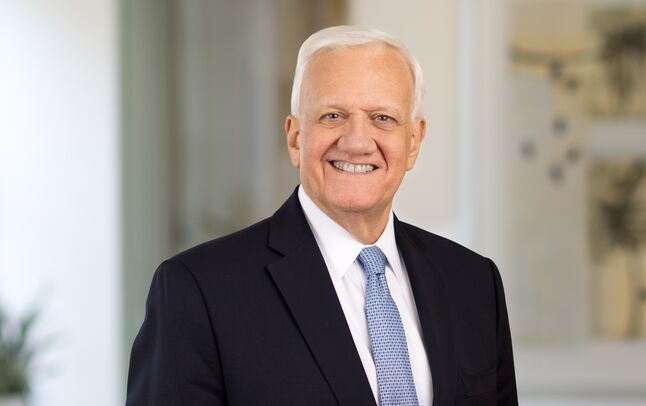

When we sat down together, I expected our conversation to revolve around procurement law, acquisition reform, and government contracts. Instead, it evolved into something much broader: a thoughtful reflection on how institutions function, why relationships matter, and what it truly means to serve the public interest. By the end of our discussion, I realized this was not simply a conversation about procurement. It was a conversation about the invisible architecture of democracy itself.
Burton never imagined this would become his life's work. After graduating from the University of Virginia School of Law, he simply hoped to remain in the Washington metropolitan area where he had grown up. Like many young lawyers in the early 1980s, he faced two obvious career paths. "Back in those days," he recalled with a smile, "you either worked for the federal government or you worked for a law firm."
Government service appealed to him, not because he had a carefully designed career plan, but because it offered stability and the opportunity to remain in Washington. When he joined the Department of Defense, however, he found himself assigned to an area he had never studied. "I didn't really pick acquisition," he admitted. "They said, 'We're going to put you in the government contracts group.' I didn't know what it was all about. All these regulations and laws and how the government buys things; it was all new to me because we didn't study that in law school." Many young professionals would have viewed such an assignment as a detour. Burton embraced it as an education. "You learn your job by doing it," he said. “It was a lot of fun. I ended up really liking my job. I also liked my boss, and job satisfaction is closely related to who you work with.”
That observation may seem simple, but it reveals something essential about his character. Throughout our conversation, Burton consistently credited people before institutions. Regulations mattered, certainly, but mentors mattered more. Policies evolved, but relationships endured. Even when discussing highly technical aspects of procurement law, he returned repeatedly to collaboration, trust, and communication.
During the next twenty years, Burton immersed himself in one of the federal government's most specialized disciplines. At the Department of Defense, he became involved not only in interpreting procurement law but in helping write the regulations governing how the Pentagon acquires products and services. Every military aircraft, communications system, naval vessel, cybersecurity platform, logistics contract, and technological innovation purchased by the Department of Defense passes through a procurement framework designed to balance competition, efficiency, transparency, accountability, and national security. Burton became one of the lawyers helping shape that framework.

Every aircraft protecting American skies, every federal technology program, every major infrastructure project, and every contract supporting the missions of the United States government begins with a fundamental responsibility: ensuring that public resources are managed wisely, transparently, and in the best interest of the American people.
To many outside government, procurement sounds administrative. Burton understands it differently. Procurement is where public policy becomes operational. It is where congressional appropriations become equipment, research, infrastructure, and capability. It is where ideas become reality.
The defining moment of his career arrived almost unexpectedly during the administration of President George W. Bush. A longtime colleague was nominated to lead the Office of Federal Procurement Policy within the Executive Office of the President and invited Burton to become her deputy. At first, he hesitated. After two decades at the Department of Defense, he identified himself as "a Department of Defense guy." Leaving a familiar institution for a small White House office seemed risky.
Looking back, he laughs at his hesitation. "It was the best move I ever made in my career."
Within little more than a year, his colleague departed, and Burton became Acting Administrator of the Office of Federal Procurement Policy. Suddenly, the lawyer who had once stumbled into government contracts found himself leading procurement policy for the entire federal government. "All of a sudden," he recalled, "I became pretty much the face of federal procurement to industry and to the United States government."
The position transformed his perspective. As Chairman of the Federal Acquisition Regulatory Council, Burton helped oversee regulations affecting every federal agency. He traveled extensively, spoke before government and industry audiences, conducted media interviews, and found himself explaining procurement not only to specialists but to policymakers, business leaders, and the public.
One conversation from those years has remained with him ever since.
Shortly after arriving at the Office of Management and Budget, which houses the Office of Federal Procurement Policy, a senior political official welcomed him with unexpected advice. "You come from the Department of Defense," Burton remembered him saying. "Forget all of that. We here in the Office of Management and Budget run the federal government."
Burton admits he was initially surprised by the statement. Today, he believes it was absolutely correct. "They control the budget," he explained. "They control the purse strings and government-wide policy. It is a great place to learn how the United States government works because, in effect, they do run the federal government."
It was there that Burton gained a deeper appreciation for leadership; not leadership defined by speeches or visibility, but leadership exercised through coordination, policy, and the ability to bring institutions together around common goals. The experience also taught him something that continues to shape his thinking today. "If you have an initiative that is somewhat ambitious," he reflected, "you will not be successful unless you have high-level support. You have got to have high-level support."
That lesson remains remarkably relevant as the United States undertakes what Burton considers the most significant procurement reform effort he has witnessed in nearly half a century. "This is the most robust acquisition reform effort I've seen in my forty-five-year career," he told me. "Everything's happening so fast." Unlike previous administrations, which often treated procurement as a technical matter, Burton believes today's reforms recognize procurement as a strategic function capable of increasing efficiency across government. Efforts to simplify the Federal Acquisition Regulation, eliminate duplication among agencies, clarify language, and modernize acquisition processes could fundamentally reshape how government operates.
Yet Burton is careful not to romanticize reform. Changing government, he reminds me, is never easy. "The government is just like molasses," he said with characteristic candor. "It is incredibly difficult to move." Unlike private companies, governments answer not to shareholders but to citizens. Every decision involves legislation, oversight, competing priorities, public accountability, and multiple stakeholders. Progress rarely happens quickly.
Ironically, it was while discussing regulations that Burton revealed what may be the most important lesson of his career. "Everything rests on good communication." The sentence came almost in passing, yet it lingered long after our interview ended.
In Burton's view, the greatest challenge facing government today is not technology, nor regulation, nor politics. It is communication.
Communication, Burton believes, has quietly become one of the greatest challenges confronting modern government. During his decades in public service and private practice, he has observed extraordinary advances in technology, dramatic changes in procurement policy, and the growing sophistication of both government agencies and private contractors. Yet, in his view, the simple act of sitting across a table from another person has become increasingly rare, and with it, an essential ingredient of effective leadership.
“Communication is very difficult in the government,” he said candidly. "It is really hard sometimes to get responses from agencies, to set up meetings, or simply to have conversations." Then he paused before adding the sentence that, perhaps more than any other during our interview, encapsulated his philosophy: "Everything rests on good communication."
It is difficult to overstate the significance of those words. Coming from someone whose career has revolved around regulations, contracts, and legal frameworks, one might expect Burton to emphasize policy above all else. Instead, he repeatedly returned to the human dimension. Regulations may establish procedures, but relationships determine whether institutions function effectively. Laws define responsibilities, but communication builds trust. In Burton's experience, many of the disputes that eventually reach lawyers or courts could have been resolved much earlier through honest conversation. "A lot of the legal disputes that I've seen throughout my career are because the parties never really communicated well," he explained. "If they had simply sat down in a room and talked to each other, many of those disputes could have been avoided."
Listening to him, I found myself thinking that his observations extend far beyond federal procurement. They apply equally to diplomacy, business, education, and international relations. French Quarter Magazine was founded on the belief that dialogue creates understanding and that understanding strengthens relationships between cultures. Burton's reflections, although rooted in government contracting, echoed precisely that philosophy. Communication is not merely an administrative tool; it is the foundation upon which institutions, partnerships, and societies are built.
The COVID-19 pandemic, Burton believes, accelerated a transformation whose consequences are only now becoming fully visible. Video conferencing enabled governments and businesses to continue operating during an unprecedented global crisis, but it also normalized a level of distance that has persisted long after offices reopened. "Video conferences are not as effective as in-person meetings," he said without hesitation. "People like having contact with other people."
His point was not nostalgic. It was practical. Relationships develop through the conversations that occur before meetings begin, during lunch, while walking between conference rooms, or simply by spending time together. Those informal moments often establish the confidence necessary to resolve far more complex issues later. "The government is no different from the private sector," Burton observed. "A lot of acquisition is based on relationships. Those relationships are built through really robust and active communication."
It is an observation that challenges a common misconception about government. Bureaucracies are often portrayed as systems governed entirely by procedures and regulations. Burton's experience suggests otherwise. Behind every institution are people. Behind every negotiation are individuals attempting to solve problems together. Even the most sophisticated regulatory framework cannot replace mutual trust.
As our conversation turned toward artificial intelligence, Burton displayed the same balanced perspective that characterized his reflections on leadership. He neither embraced AI uncritically nor rejected its growing role in government. Instead, he viewed it as another tool whose value depends entirely upon how wisely human beings choose to use it.
Today, artificial intelligence is already transforming procurement. Contractors increasingly rely on AI to prepare responses to Requests for Proposals. Law firms use it to accelerate research and draft documents. Government agencies are experimenting with AI to evaluate procurement submissions and streamline administrative processes.
Only a few years ago, Burton recalled, many lawyers dismissed the technology entirely. "People used to say AI could never come into the legal marketplace because lawyers are special," he said with a laugh. "Today, AI training is mandatory for every lawyer in my law firm."
Its capacity to save time is undeniable. Tasks that once required hours of legal research can now be completed in minutes, allowing professionals to devote more attention to analysis and judgment. Yet Burton remains convinced that artificial intelligence must never replace human accountability.
During our conversation, I mentioned the French philosopher Luc Ferry, who has argued that humanity should use artificial intelligence to assist people; not become servants to artificial intelligence itself. Burton immediately embraced the idea. "There is a feeling that we can't have AI deciding who wins and loses government contracts," he said. "The government is still trying to figure out to what extent to use it."
His response reflected a broader challenge confronting governments around the world. Artificial intelligence offers extraordinary opportunities to improve efficiency, reduce costs, and process information at unprecedented speed. At the same time, public institutions must ensure that transparency, ethics, and human responsibility remain central to decision-making. In procurement, where taxpayer money, competition, and public confidence intersect, that balance becomes especially important.
Ethics, unsurprisingly, remains one of Burton's enduring concerns. Throughout his career, he has watched procurement evolve into one of the most highly regulated areas of public administration. Contractors certify compliance with countless legal requirements, procurement officials receive extensive ethics training, and agencies devote significant resources to preventing conflicts of interest and fraud. "You are in charge of the taxpayers' money," Burton reminded me. "So there are special obligations and ethical rules that apply."
Those responsibilities, however, extend beyond government employees. Companies seeking to do business with the federal government face an increasingly complex landscape of certifications, compliance standards, and legal obligations. Burton has spent nearly two decades helping clients navigate those requirements, and he understands how intimidating they can appear, particularly for smaller organizations without extensive legal resources. "There are enormous numbers of ethical and standards-of-conduct rules," he explained. "Sometimes companies that can't afford expensive lawyers don't even know exactly what they're certifying."
The consequences of mistakes can be severe. False statements to the federal government carry significant legal penalties, even when errors result from misunderstanding rather than intentional misconduct. Burton therefore views ethics not simply as a matter of enforcement but as one of education. Helping organizations understand their responsibilities ultimately strengthens the integrity of the entire procurement system. That concern naturally led our conversation toward one of the subjects about which Burton speaks with particular conviction: the future of America's small businesses.
He worries that the federal marketplace is becoming increasingly difficult for innovative entrepreneurs to enter. Over the past two decades, the number of companies choosing to compete for government contracts has steadily declined. "The number of small businesses dealing with the United States government has decreased significantly," he said. "A lot of companies simply say, 'I think I'll take a pass on the federal government.'"
The reasons are understandable. Compliance requirements continue to expand, cybersecurity standards require costly investments, and administrative burdens often overwhelm smaller firms with limited resources. For Burton, this trend represents more than a procurement issue. It is a question of national competitiveness. "Small businesses are the engine that drives the economy," he said. They are often the source of the country's most creative ideas, emerging technologies, and entrepreneurial energy. Yet many conclude that the cost of doing business with the federal government outweighs the potential benefits. Burton fears that, in losing these companies, government may also lose access to innovation itself. "The government does not have access to many of those innovative ideas because companies decide not to participate," he observed thoughtfully.
To him, the challenge is finding an appropriate balance, maintaining rigorous protections for taxpayers while ensuring that regulation does not become an obstacle to creativity, competition, and economic growth.
As I listened, it became increasingly clear that Burton's reflections were never simply about procurement. They were about leadership in its broadest sense: how institutions adapt, how trust is maintained, how innovation is encouraged, and how societies preserve both accountability and openness in an era of extraordinary change.


Comments