
Preserving the Imagination of Jean Schlumberger
A jewel may begin with a gemstone, but an artistic legacy often begins with paper: a pencil line, a wash of gouache, a half-formed creature or a note exchanged with a friend. Thousands of those traces survive in Paris, where Tiffany & Co. and the Musée des Arts Décoratifs have begun an ambitious effort to preserve the creative world of Jean Schlumberger.
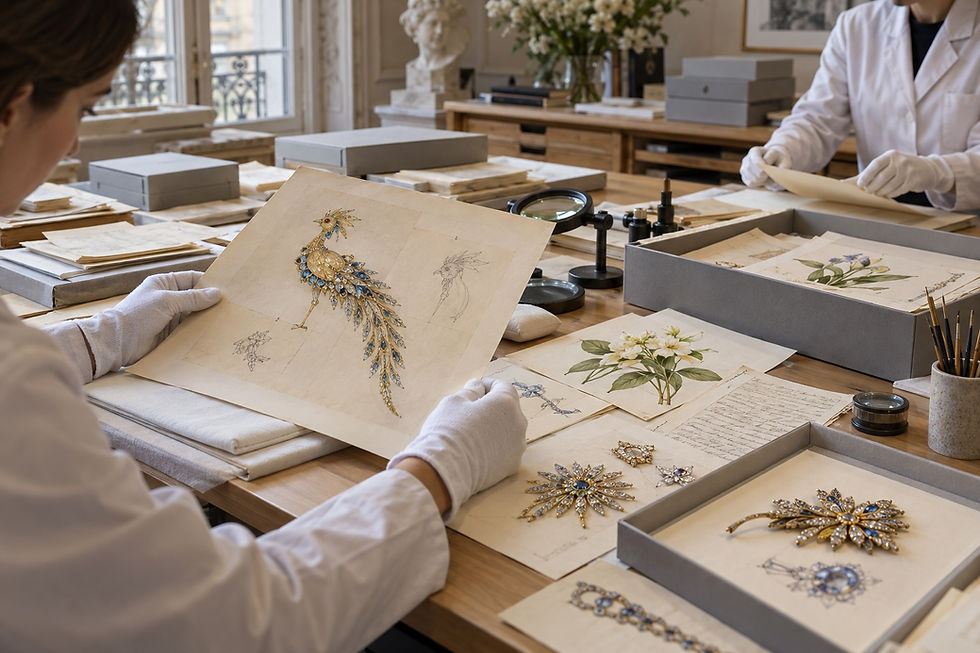
The four-year partnership will support the inventory, conservation, restoration and digitization of more than 5,000 designs, sketches and gouaches held by the museum, along with approximately 5,000 documents tracing Schlumberger’s personal and professional life. The initiative was launched during Paris Fashion Week in 2026 with a presentation bringing archival materials into conversation with finished jewels and objects.
The numbers are impressive, but they only begin to explain the project’s importance. Archives reveal what the finished object cannot: uncertainty, experimentation, rejected ideas and the patient development of a visual language. In Schlumberger’s case, they allow scholars and future designers to follow the transformation of an observation in nature into an object of extraordinary craftsmanship.
Born in Alsace in 1907 to a family of textile manufacturers, Schlumberger was expected to pursue business rather than art. He moved to Paris and began creating ornaments from objects found at flea markets before Elsa Schiaparelli recruited him in 1937 to design imaginative buttons and costume jewelry. After serving in the French forces during the Second World War, he established himself in New York with Nicolas Bongard. In 1956, Tiffany chairman Walter Hoving invited him to join the American house as vice president and gave him a private studio and salon at its Fifth Avenue flagship.
That journey—from Alsatian textile heritage and Parisian Surrealism to postwar New York—helps explain why Schlumberger remains such a compelling French-American figure. His work was neither conventionally French nor simply American. It carried the refinement of European decorative arts into the confidence and international reach of an American luxury house.
Schlumberger treated jewelry as a form of sculpture in motion. Shells, birds, flowers, stars and sea creatures became fantastical constructions in gold, enamel, diamonds and vividly colored gemstones. His family’s textile background resurfaced in braided ropes, ribbons, tassels and woven gold. Rather than reproducing nature faithfully, he animated it, giving plants and animals a sense of growth, surprise and personality.
His most recognizable creation, Bird on a Rock, appeared in 1965: a small jeweled bird perched with improbable confidence upon a monumental gemstone. The design has remained an emblem of Tiffany ingenuity for more than half a century and continues to be reinterpreted across the house’s high-jewelry and fine-jewelry collections.
Yet famous objects can obscure the labor that made them possible. A completed jewel presents certainty; an archive preserves the process that preceded it. Schlumberger’s drawings document how proportion was adjusted, how movement was suggested and how an organic form could be translated into metal without losing its vitality. His correspondence, photographs and personal papers can also illuminate the relationships that shaped his work.
Among the most important was his friendship with American horticulturalist, collector and philanthropist Rachel Lambert “Bunny” Mellon. Mellon owned more than 100 Schlumberger jewels and objects, and the Virginia Museum of Fine Arts now holds a major collection connected with her patronage. Materials from that collection accompanied the Paris launch, demonstrating how Schlumberger’s legacy extends across institutions as well as nations.
The partnership also illustrates an important evolution in cultural patronage. Tiffany is not merely lending recognizable jewels for a temporary exhibition. It is financing the quieter work upon which serious exhibitions and scholarship depend: cataloguing, conserving and digitizing fragile source material.
There is, of course, a commercial dimension. Schlumberger’s visual language remains central to Tiffany’s contemporary identity. Chief artistic officer Nathalie Verdeille and chief gemologist Victoria Reynolds continue to study his drawings when developing new creations, and recent collections have returned to his fascination with gardens, oceans and the sky. Preserving the archive therefore strengthens both public knowledge and the house’s own creative capital.
That overlap should not automatically diminish the project. Luxury houses possess archives, specialist knowledge and financial resources that museums often need. Museums, in turn, provide conservation expertise, scholarly independence and public access. The value of such a partnership depends on whether corporate support enables genuine research and preservation rather than reducing cultural history to brand promotion.
Here, the practical work matters. Once inventoried and digitized, fragile drawings can be studied without repeated physical handling. Researchers can establish connections among designs, commissions, correspondence and completed jewels. Curators can construct more precise exhibitions. Students and craftspeople can encounter not only Schlumberger’s celebrated objects but also the decisions that produced them.

For Tiffany, the project confirms that heritage is an active business asset rather than a decorative reference to the past. For the Musée des Arts Décoratifs, it creates the conditions necessary to safeguard and interpret one of the twentieth century’s most significant jewelry archives. For the public, it promises a fuller understanding of an artist whose work moved between France and the United States, fashion and sculpture, imagination and exacting craft.
Jean Schlumberger once described jewelry as a means of expression capable of creating lasting beauty beyond the ordinary limits of fashion. The survival of that expression now depends on something far less glamorous than diamonds: careful cataloguing, conservation, scholarship and time.
That may be the partnership’s most valuable lesson. Heritage does not endure simply because an object is beautiful or a name is famous. It endures because institutions and individuals accept responsibility for preserving the evidence of how beauty was imagined—and make that knowledge available to those who will come next.




Comments