
Why the World Still Pays for the Human Hand

In an age when technology promises to make almost everything faster, cheaper and more precise, luxury continues to place extraordinary value on something decidedly old-fashioned: the human hand. A hand-embroidered evening dress, a perfectly fitted haute couture jacket, a marquetry cabinet or a piece of needle lace may require hours, weeks or even months of work. Their value is not determined by material alone. It comes from the accumulated knowledge of someone who has learned how to transform that material exceptionally well.
France has made this knowledge part of its cultural and economic identity. The country officially recognizes 281 métiers d’art, encompassing highly skilled professions across fashion, jewelry, architecture, furniture, decorative arts and heritage restoration. The French Ministry of Culture describes these as professions requiring highly technical traditional savoir-faire and often years of practice before a gesture is mastered.
The scale is greater than the romantic image of the solitary artisan might suggest. According to the Institut pour les Savoir-Faire Français, France's broader exceptional-savoir-faire economy represents approximately 234,000 businesses, 500,000 workers and €68 billion in revenue. Craftsmanship is therefore not simply an attractive remnant of the past. It is an economy.
Paris offers an especially vivid illustration this autumn. Until October 18, 2026, the Palais Galliera's exhibition Tisser, broder, sublimer. Les savoir-faire de la mode examines the extraordinary network of craftspeople behind fashion through more than 350 garments, accessories, samples, documents and tools. Embroiderers, feather workers, pleaters, jewelers and other specialists emerge from behind the finished dress and become part of the story themselves.

It is an important distinction. Fashion celebrates the designer, but the designer's idea frequently depends upon an entire constellation of highly trained hands to become reality. A sketch can propose an extraordinary surface; someone must know how to embroider it. A silhouette may require a particular structure; someone must understand how fabric behaves on the body. A feather can appear effortless on a runway precisely because a specialist has spent years learning how to manipulate something extraordinarily delicate.
At le19M, Chanel has brought together many of these métiers under one roof. The site houses nearly 700 artisans, including the celebrated embroidery house Lesage and other specialist maisons working in embroidery, feathers, pleating, millinery, footwear, goldsmithing and related crafts. Lesage itself was founded in 1924 and became part of Chanel's Métiers d'Art in 2002.
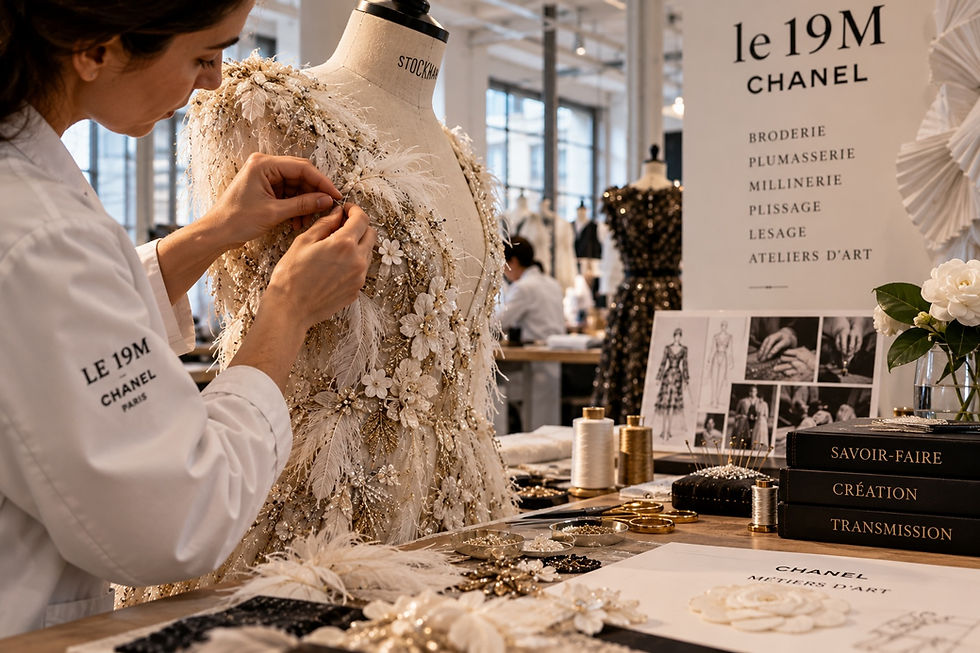
The significance extends well beyond Chanel. These métiers form part of an ecosystem that has helped make Paris one of the world's enduring capitals of luxury. Haute couture itself remains defined partly by what the Fédération de la Haute Couture et de la Mode calls the “intelligence of the hand” and the savoir-faire of the ateliers.
Yet there is a vulnerability hidden inside all this beauty: rare knowledge can disappear. France is now confronting a generational challenge as experienced craftspeople approach retirement. Beginning with the 2026 academic year, a new specialized diploma for the Première Main Haute Couture, the highly skilled atelier professional responsible for helping realize couture garments, has been created with the French Ministry of Education, haute couture houses, the Fédération de la Haute Couture et de la Mode and support from the Institut Français de la Mode. The program was designed with atelier experts specifically to transmit the technical gestures required by the profession.
This is where the question of luxury becomes a question of economics. If consumers no longer recognize the difference between something painstakingly made and something convincingly manufactured, there is less reason for companies to maintain expensive ateliers and train another generation. But when clients are prepared to pay for mastery, craftsmanship acquires an economic future. Demand can preserve knowledge.
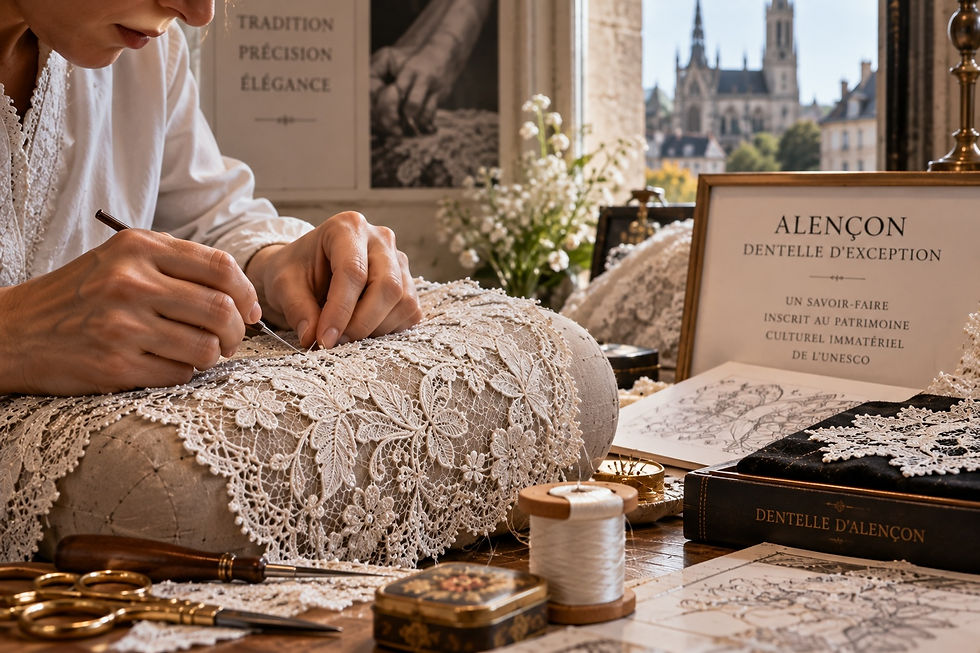
The relationship between price and time becomes particularly striking in some métiers. UNESCO notes that traditional Alençon needle lace, one of France's remarkable specialist crafts, can require approximately seven hours to produce a single square centimeter. In a conventional manufacturing calculation, that sounds almost irrational. In the world of exceptional craftsmanship, the time itself becomes part of what makes the result rare.
Technology need not be the enemy of this tradition. France's Directorate-General for Enterprise is itself encouraging artisans to adopt innovations that can reduce physical strain, save time, improve profitability and help preserve savoir-faire. The future may therefore lie not in choosing between machine and artisan, but in deciding intelligently which tasks technology should assume and which require human judgment.
That distinction may become increasingly valuable. A machine can reproduce a pattern with extraordinary accuracy. It can cut, measure and calculate. Artificial intelligence can generate thousands of variations almost instantly. What remains harder to reproduce is discernment; the experienced eye that knows when a proportion is wrong, the hand that understands how much tension a material can accept, or the craftsperson who recognizes that technical perfection is not necessarily beauty.
Luxury has always traded partly on scarcity. For much of history, that scarcity came from materials, access or wealth. In the future, one of the rarest commodities may be time spent by someone who truly knows what he or she is doing.
That is why the human hand still commands a premium. We are not simply paying for hours of labor. At its best, we are paying for years of learning contained within those hours. And perhaps that is one of the most compelling definitions of modern luxury: not something made slowly for the sake of being expensive, but something made exceptionally because someone still possesses the knowledge to make it that way.
Sources:
French Ministry of Culture: France’s 281 métiers d’art. Ministère de la Culture
Palais Galliera: Tisser, broder, sublimer exhibition. Palais Galliera
Fédération de la Haute Couture et de la Mode: Première Main Haute Couture training. FHCM
UNESCO: Alençon needle lace craftsmanship. UNESCO


Comments