
What will we leave behind? Leadership, commitment, and America at 250

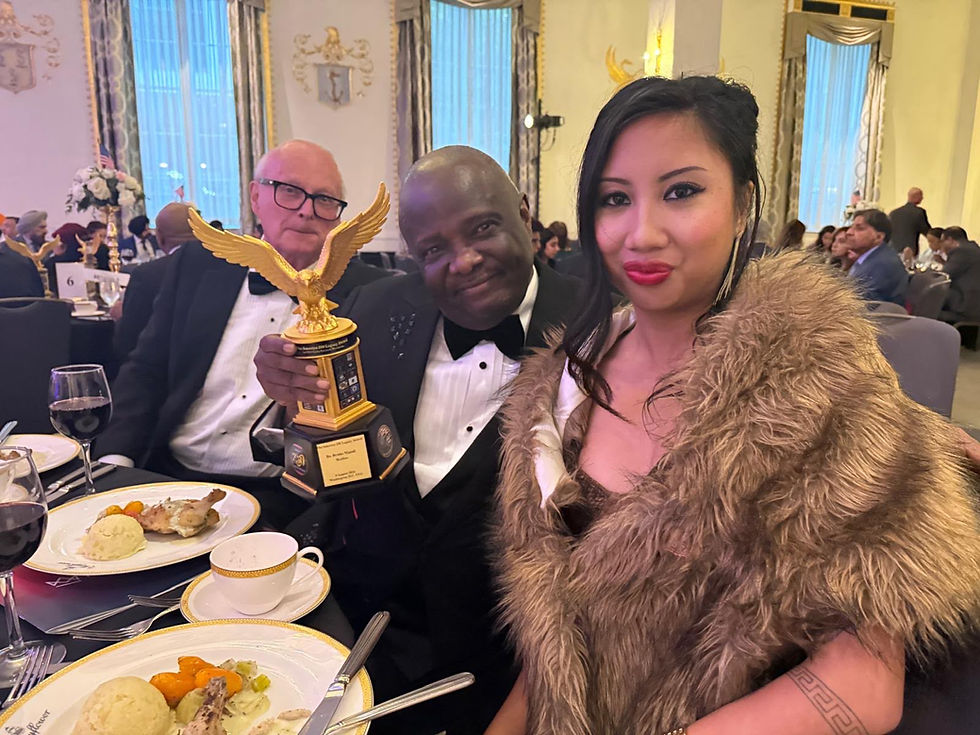
On August 9, 2026, the historic Mayflower Hotel in Washington, D.C., became the setting for an evening devoted not simply to achievement, but to the idea of legacy itself. The America 250 Legacy Awards & Celebration, presented by CEO Clubs Network, brought together award recipients, embassy representatives, business leaders, executives, and distinguished guests from around the world at a particularly symbolic moment: the 250th anniversary of the United States.
Awards are traditionally designed to recognize what has already been accomplished. Anniversaries, by contrast, invite us to look backward only long enough to ask what should come next. When the two converge during America’s semiquincentennial, the word legacy takes on greater meaning. What makes a life, an institution, or even a nation consequential? Is legacy measured by titles, honors, and recognition or by the doors we open, the relationships we build, and the opportunities we create for people who may never appear beside us in the photographs?

That question felt especially relevant as Dr. Bruno Mazali, French Quarter Magazine’s Washington, D.C. Correspondent, was honored with the America 250 Legacy Award. For the FQM family, his recognition was naturally a source of pride. Yet the more compelling story lies beyond the award itself. Mazali’s work, spanning entrepreneurship, humanitarian initiatives, community engagement, and international relationship-building, offers a lens through which to consider a larger question at this defining moment in American history: what kind of leadership deserves to become a legacy?
“I am deeply blessed and honored to receive the America 250 Legacy Award from the CEO Clubs Network,” Mazali told me following the recognition. His first instinct was not to speak about himself, but to acknowledge those responsible for the honor. “I would like to extend my heartfelt gratitude to Sarah Dong (the wife of the CEO) and the entire CEO Clubs Network team for selecting me for this memorable honor. I am truly grateful for your recognition and support.”

That sense of gratitude matters, because awards can easily become exercises in self-congratulation. The more compelling interpretation is to regard recognition as a moment of accountability. If someone is publicly described as a leader, what should leadership actually require of that person afterward? Mazali has spent more than two decades developing relationships across business, government, nonprofit organizations and international communities in the Washington region and beyond. CEO Clubs Network, in announcing his recognition, described him as a community leader, entrepreneur, global advocate and Ambassador of Peace whose work has focused on entrepreneurship, humanitarian service and community development. Through MazaliNet Global Connections, he has continued to emphasize entrepreneurship, international cooperation, sustainable development, leadership and mentorship. Yet the vocabulary surrounding international leadership can sometimes become deceptively impressive. We hear constantly about global impact, strategic partnerships, international cooperation, networking and sustainable development. They are useful expressions, but they are also abstractions. The more important journalistic question is much simpler: what changed for another human being because of the work?


Mazali points to the COVID-19 pandemic as one answer. At a moment when businesses were closing and entrepreneurs around the world were confronting extraordinary uncertainty, he helped launch more than 2,000 online businesses, according to the citation accompanying his award. The statistic is impressive, but its significance lies beyond the number. For a small-business owner suddenly deprived of customers, moving online was not necessarily a fashionable embrace of digital innovation. It could mean preserving an income, supporting employees or keeping alive something a family had spent years building.
Mazali also supported public-health efforts in Montgomery County through mask distribution and COVID-19 testing initiatives. That work appears very different from international business development, but perhaps it illustrates something important about leadership: its value is revealed not only in prestigious rooms, but in moments when a community simply needs people willing to help.
“This award recognizes my efforts and work around the world to create opportunities, promote humanitarian initiatives, strengthen collaboration between nations, and support meaningful partnerships connected with the United Nations and the global community,” Mazali said. The sentence contains a word that appears repeatedly when he describes his work: opportunity.
It is an interesting measure of leadership because opportunity is difficult to display. Buildings can carry names. Awards can sit on shelves. Titles fit neatly beneath photographs. Opportunity is less visible. It may take the form of an introduction between two people, assistance given to an entrepreneur, a partnership created between organizations or a young person encountering someone willing to open a door.
Perhaps that is precisely why it matters.
Washington, D.C., is one of the world's great capitals of connection. Within a relatively small geographical area sit the White House and Congress, embassies representing countries from across the globe, international financial institutions, universities, think tanks, nonprofits, corporations, cultural organizations and advocacy groups. The city possesses an extraordinary density of people with access to influence.
But proximity is not the same thing as collaboration.
Thousands of influential people can occupy the same city without ever meaningfully encountering one another. Diplomats can attend receptions together without creating diplomacy. Executives can exchange business cards without creating commerce. Organizations can speak endlessly about partnership without ever building one.
The difficult work begins after the introduction. That is one reason the philosophy of CEO Clubs Network is relevant to Mazali's recognition. Founded by Dr. Tariq Ahmed Nizami, the organization has developed an international network intended to connect C-level executives and leaders across private and government sectors. With a presence in the United States, the United Arab Emirates and China and relationships extending across more than 50 countries, its stated objectives include building communities, sharing knowledge and facilitating business, trade, investment and collaboration. “The CEO Clubs Network continues to build bridges and connect leaders around the world,” Mazali observed.


Building bridges is another expression frequently used in international circles, and one that resonates strongly with the mission of French Quarter Magazine. But bridges are valuable only when people actually cross them.
That distinction is worth making as America celebrates its 250th anniversary. The United States has always existed within an international story. The country's independence itself cannot be separated from foreign alliances, most notably the decisive French alliance during the American Revolution. Successive generations of immigrants, entrepreneurs, scientists, artists, diplomats and thinkers from around the world have contributed to the country that America became.
Two hundred and fifty years later, interdependence has become even more pronounced. Capital, technology, ideas, culture and information move across borders with extraordinary speed. So do crises. Pandemics do not stop at customs checkpoints. Neither do climate challenges, economic disruptions or humanitarian emergencies.
Leadership in such a world cannot consist simply of accumulating access. Access is not impact.
Knowing influential people is not the same as accomplishing influential things. A photograph with an ambassador does not constitute diplomacy. Attending an international conference does not automatically produce international cooperation. A large network is not necessarily a meaningful one. The real test is what moves through that network. Knowledge? Investment? Opportunity? Mentorship? Humanitarian assistance? Cultural understanding? Trust? Or simply names?
Mazali's own language suggests that he understands this distinction. “Together, we can create opportunities, build bridges, serve humanity, and make a positive impact around the world,” he said after receiving the award. The word together may be the most important one in that sentence. Modern culture often presents leadership as an individual performance. We celebrate founders, presidents, CEOs, innovators and public figures. Their names become shorthand for achievements that were almost always collective. Yet the most consequential challenges facing societies today are too complicated for individual heroism. They require institutions, governments, businesses, communities and people from different cultures to cooperate.
The history commemorated by America's 250th anniversary itself demonstrates this. Nations are not built by one generation, one profession or one kind of person. They are cumulative projects. Each generation inherits institutions and ideas it did not create, alters them and passes something onward. Which returns us to the uncomfortable word at the center of the award: legacy. What is it? Legacy is often confused with reputation. The two are not the same. Reputation is what people say about us. Legacy is what continues because we were here.
The distinction changes the questions we should ask of people who are recognized as leaders. Instead of asking how many important people they know, perhaps we should ask how many people they helped become important in their own right. Instead of asking how many events they attended, we might ask what emerged from those encounters. Instead of measuring influence by access to powerful rooms, perhaps we should examine whether that access was ever used to open the door for someone else.
For Mazali, mentorship is part of that equation. His work through MazaliNet includes supporting emerging entrepreneurs and future leaders. That may prove more consequential over time than any individual transaction or ceremony because mentorship contains a multiplier effect. Help one person become capable of helping ten others, and influence begins to travel beyond its original source.
There is also something particularly appropriate about examining these questions from Washington during America's semiquincentennial. The capital is filled with monuments to legacy. Presidents are carved into stone. Wars are remembered in granite. Names cover buildings, museums and institutions. The physical city continually reminds visitors of individuals and events deemed worthy of remembrance.
Yet many of the people who shaped America's history have no monument. They taught children. Built businesses. Raised families. Created inventions. Served communities. Arrived from other countries. Volunteered. Introduced people. Helped neighbors. Offered someone a first opportunity. History tends to remember the visible.
Societies depend equally upon the invisible. Perhaps the most useful way to understand an award for leadership, therefore, is not as the conclusion of a story but as an interruption in it; a moment when the recipient is briefly asked to look backward before returning to the work ahead. Mazali himself seems to view the honor in those terms. “Thank you, CEO Clubs Network, for this extraordinary recognition,” he said. “I am sincerely grateful, humbled, and honored to be part of this remarkable global community.”

For French Quarter Magazine, his recognition carries another dimension. Bruno represents FQM in Washington at a moment when our editorial work increasingly examines the territory where culture, diplomacy, heritage and human relationships intersect. Those subjects may appear distinct, but ultimately they revolve around the same fundamental question: how do people who come from different histories learn to understand one another well enough to create something together?
Cultural diplomacy does not always take place across negotiating tables. Sometimes it begins with a conversation at an exhibition, an embassy reception, a university, a cultural celebration or a dinner where two people discover an unexpected common interest. Business diplomacy can begin in much the same way. So can humanitarian cooperation. But we should resist romanticizing connection for its own sake. A bridge that leads nowhere is merely architecture. The measure of any network, whether diplomatic, cultural, humanitarian or commercial, is ultimately what becomes possible because it exists.
That is why the America 250 moment offers an opportunity not simply to honor leaders but to question leadership itself.
His words after receiving the award were simple: “Together, we can create opportunities, build bridges, serve humanity, and make a positive impact around the world.” Perhaps that is where the real story of this recognition begins. An award records a moment. A photograph preserves it. A biography eventually lists it among other accomplishments. But none of those things, by themselves, constitute a legacy.
The better question for Bruno, for every leader honored during America's 250th anniversary, and perhaps for all of us is far more demanding: What became possible for someone else because we were here?
If we can answer that question, perhaps we begin to understand what legacy actually means.


Comments