
Under Titan's Orange Skies: France at the Heart of Humanity's Search for Life

For centuries, humanity has looked toward the heavens and wondered whether life exists elsewhere in the universe. Philosophers debated the question long before modern science could begin to answer it. Astronomers mapped planets and moons. Writers imagined civilizations beyond Earth. Yet only in recent decades have space agencies developed the tools capable of investigating one of the most profound questions in human history: how does life begin?
In that search, one destination has increasingly captured the attention of scientists around the world.
Not Mars.
Not the Moon.
But Titan, Saturn's largest moon.

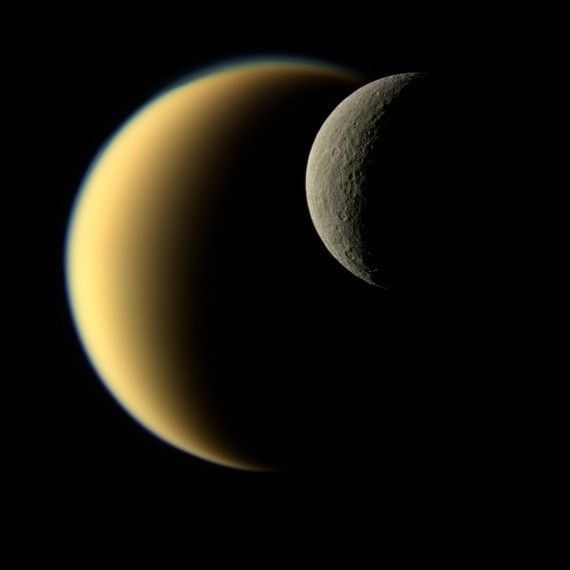
Often described as one of the most intriguing worlds in the solar system, Titan is unlike any other known celestial body. Wrapped in a dense golden atmosphere, covered with rivers and lakes of liquid methane, and rich in complex organic chemistry, Titan is considered by many planetary scientists to be one of the best natural laboratories for understanding the chemical conditions that may have preceded life on Earth billions of years ago.
In 2028, NASA plans to launch one of the most ambitious scientific missions ever conceived: Dragonfly, an autonomous nuclear-powered rotorcraft weighing more than 850 kilograms that will travel across nearly 1.4 billion kilometers of space before reaching Titan in late 2034. Unlike traditional rovers limited to a single landing site, Dragonfly will fly from location to location, exploring dunes, plains, and impact craters across Titan's frozen landscape.

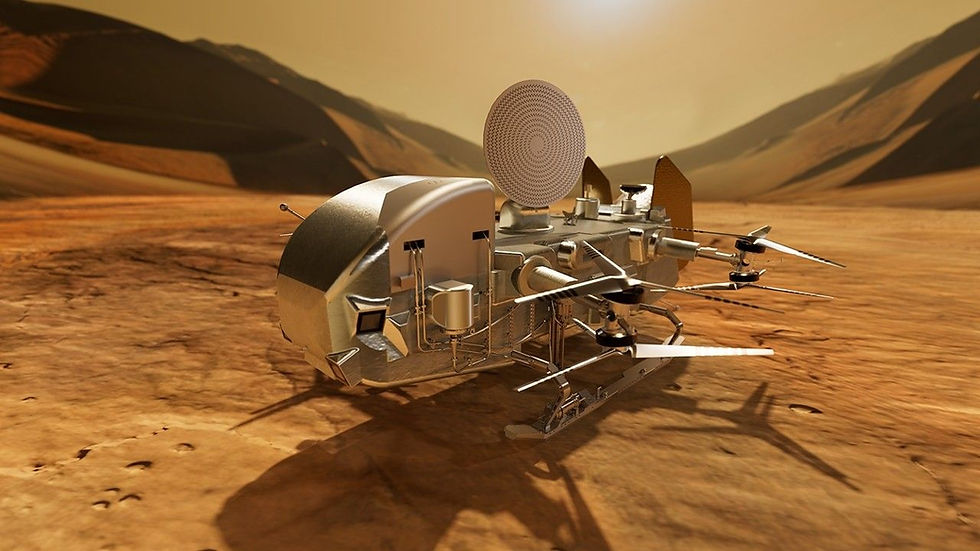

The mission represents a major technological leap.
Never before has NASA attempted an airborne scientific exploration mission of this scale on another world. While the Ingenuity helicopter demonstrated powered flight on Mars between 2021 and 2024, Dragonfly is an entirely different undertaking. It is larger, more complex, powered by a radioisotope thermoelectric generator, and designed not as a technology demonstration but as a full-scale scientific laboratory capable of operating for years.
Yet one of the most remarkable aspects of the mission is that France stands at its scientific heart.
Far from being a secondary participant, French researchers and engineers are responsible for one of Dragonfly's most critical instruments: DraMS-GC, the gas chromatography subsystem of the Dragonfly Mass Spectrometer. This sophisticated instrument has been developed under the leadership of the Centre National d'Études Spatiales (CNES) and the Laboratoire Atmosphères, Milieux, Observations Spatiales (LATMOS), in collaboration with several French research laboratories.
On May 6, 2026, a major milestone was reached when the French-built module was officially delivered to NASA's Goddard Space Flight Center in Maryland for integration into the Dragonfly spacecraft. The handover represented the culmination of years of scientific collaboration between France and the United States.
To understand the importance of this achievement, one must first understand Titan itself.
Discovered in 1655 by the Dutch astronomer Christiaan Huygens, Titan remained largely mysterious for centuries. Even powerful telescopes revealed little more than an orange sphere hidden beneath thick atmospheric haze.
Everything changed in the late twentieth century.
Beginning in 1997, the joint NASA-European Space Agency Cassini-Huygens mission transformed humanity's understanding of Saturn and its moons. The mission reached Saturn in 2004, and on January 14, 2005, the European-built Huygens probe descended through Titan's atmosphere before landing on its surface. It remains, to this day, the most distant landing ever achieved by humanity.
The images stunned scientists.
Instead of a barren frozen wasteland, Titan revealed landscapes shaped by weather, rivers, lakes, erosion, and atmospheric cycles. The moon possessed meteorological systems strikingly reminiscent of Earth, except that methane and ethane played the role that water plays on our planet.
Even more intriguing was Titan's chemistry.
Its atmosphere contains nitrogen, methane, and a remarkable abundance of complex organic molecules. While Titan is far too cold to support life as we know it today, scientists increasingly view it as a window into the distant past of our own world. Before life emerged on Earth, similar organic compounds may have existed within our planet's primitive atmosphere and oceans. Titan therefore offers researchers a chance to study chemical processes that may resemble those that preceded biology itself.
As Dragonfly principal investigator Elizabeth "Zibi" Turtle has explained, the mission is not designed to detect life directly but rather to investigate the chemistry that existed before life emerged. NASA describes Dragonfly as a mission focused on understanding "the progression of prebiotic chemistry" and the environmental conditions that make worlds potentially habitable.
This is where the French instrument becomes indispensable.
Once Dragonfly lands within the Selk impact crater region, DraMS-GC will analyze samples collected from Titan's surface. The instrument's gas chromatograph will separate complex organic molecules before the mass spectrometer identifies their chemical composition. Scientists hope these measurements will reveal whether Titan possesses molecular structures similar to those that once existed on the young Earth.
In many ways, the instrument functions as the mission's chemical detective.
Without it, researchers would be unable to determine precisely which organic compounds are present in Titan's environment. The data may help answer one of the most enduring scientific questions of all: how does chemistry become biology?
The French contribution also reflects a long tradition of Franco-American cooperation in planetary science.
France has played major roles in numerous international space missions, from the Rosetta comet mission to Mars exploration programs and Earth observation satellites. The Dragonfly partnership formally took shape on March 14, 2022, when NASA and CNES signed a cooperation agreement defining France's participation in the mission.
For CNES and LATMOS, Dragonfly represents not only a technological achievement but also a continuation of Europe's deep involvement in Titan exploration dating back to Huygens.
The symbolism is striking.
Twenty-nine years after Cassini-Huygens launched toward Saturn in 1997, and nearly three decades after the first European probe touched Titan's surface in 2005, a new generation of scientists is preparing to return. This time, however, humanity will not simply land.
It will fly.
Titan is uniquely suited for aerial exploration. Its atmosphere is approximately four times denser than Earth's while its gravity is only about one-seventh as strong. Engineers frequently describe Titan as one of the easiest places in the solar system for powered flight. NASA scientists have even remarked that Titan "practically dares you to fly."
Dragonfly will take full advantage of those conditions.
Over the course of its planned mission, the rotorcraft is expected to travel across multiple scientific sites, covering distances impossible for conventional planetary rovers. It will investigate organic dunes, impact structures, geological formations, and regions where liquid water may once have interacted with complex carbon chemistry.
The mission's timeline itself reflects the scale of interplanetary exploration.
After launching in 2028 aboard a Falcon Heavy rocket, Dragonfly will undertake a journey lasting nearly seven years before reaching Saturn's system. Arrival is expected in late 2034, followed by a nominal mission lasting at least two and a half years.
For many of the scientists currently working on the project, the discoveries they seek may not arrive until the middle of the next decade.
Space exploration has always demanded patience.
Yet the rewards can be transformative.
The Huygens landing in 2005 fundamentally altered our understanding of Titan. Cassini reshaped planetary science. Dragonfly may go even further by revealing how complex organic chemistry evolves in environments radically different from Earth.
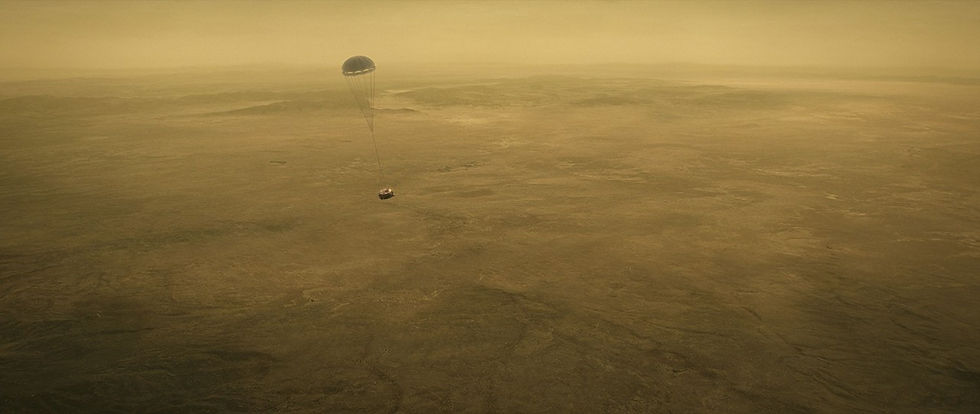
At a moment when humanity increasingly searches for life beyond our planet, France finds itself playing a central role in one of the most ambitious astrobiology missions ever undertaken.
When Dragonfly finally descends through Titan's orange skies in 2034, carrying within it the French-built DraMS-GC instrument, the mission will embody more than scientific curiosity.
It will represent a centuries-old human desire to understand where we come from — and whether we are alone.
Sources:
NASA Dragonfly Mission;
NASA Goddard Space Flight Center;
NASA Astrobiology Program;
CNES Dragonfly Mission Documentation;
CNES announcement on DraMS-GC delivery (May 2026);
LATMOS research materials;
Johns Hopkins Applied Physics Laboratory mission documentation.


Comments