
Behind the Doors of the World’s Great Luxury Houses

Luxury is most often encountered at the end of a very long journey. We see the finished handbag beneath the lights of a boutique, the watch resting perfectly inside its case, the bottle of Champagne presented at dinner, or the immaculate pair of shoes whose apparent simplicity conceals hours of highly specialized work. What we rarely see is everything that came before: the workshop, the archive, the vineyard, the inherited gesture, and the craftspeople whose expertise can take years sometimes generations to acquire.

From October 16 to 18, 2026, some of those normally private worlds will open their doors for the sixth edition of LVMH’s Les Journées Particulières. The program encompasses 71 locations belonging to 45 Maisons across 13 countries, from workshops and manufactures to cellars, historic residences and boutiques. Created in 2011 and offered free to the public, the initiative turns the usual experience of luxury inside out: instead of seeing only the finished object, visitors encounter the places and people responsible for creating it.

The 2026 theme, “At the Source of Dreams,” is particularly fitting. Luxury has become such an overused word that almost anything expensive can be described as luxurious. The great historic houses make a more demanding argument: that enduring luxury depends upon provenance, materials, imagination, human skill and continuity. A beautiful object may attract us initially, but its deeper value often resides in knowledge that cannot be seen.

In Paris, Berluti will open its bespoke footwear workshop, while Louis Vuitton will welcome visitors to its historic Asnières site and its Paris prototype workshop. Other participating names and places range from Bvlgari and Repossi to Samaritaine and the photographic archives of Paris Match. In Switzerland, TAG Heuer will reveal aspects of watchmaking at its La Chaux-de-Fonds manufacture. In Champagne, Veuve Clicquot will welcome visitors at the Hôtel du Marc and Manoir de Verzy.
These are very different worlds, yet they share an essential relationship between place, expertise and enterprise. Louis Vuitton began as a trunk maker responding to a changing culture of travel. Edouard Heuer established his watchmaking workshop in 1860. Across fashion, jewelry, wines and spirits, hospitality and the decorative arts, many celebrated maisons began with an individual who possessed not only creative talent but entrepreneurial instinct; the ability to transform expertise into a business capable of enduring beyond its founder.
That history is particularly relevant today because craftsmanship cannot survive on admiration alone. Workshops must be financed. Apprentices must be trained. Historic properties and archives require investment. And there must be clients willing to recognize the difference between something that is merely expensive and something that is exceptionally made.
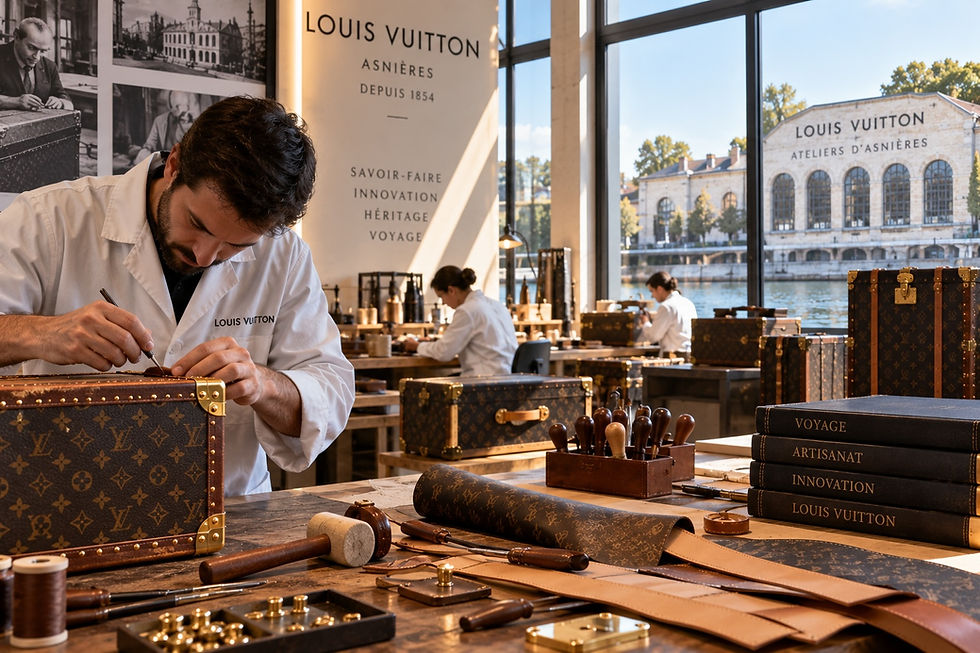
LVMH has consequently invested heavily in transmitting specialist skills. Its Institut des Métiers d’Excellence, established in 2014, trains apprentices in métiers spanning craftsmanship, creation and client experience. The initiative points to one of the less visible challenges facing the luxury industry: a company can own a trademark and an archive, but it cannot simply own the knowledge residing in an artisan’s hands. When that knowledge is not transmitted, part of the heritage disappears.
There is something almost countercultural about this idea. Much of the modern economy rewards speed, automation and scale. At the highest levels of luxury, time can become part of the value. A bespoke shoe, a mechanical watch, an embroidered garment or a carefully aged wine derives part of its distinction from expertise and processes that cannot or should not be hurried.
Technology will undoubtedly transform these industries. Artificial intelligence, robotics and advanced manufacturing will make precision easier to reproduce. Yet that may make human discernment more valuable rather than less. Knowing which leather to choose, how a fabric should fall, when a mechanism is properly adjusted or how far a historic object should be restored involves judgment accumulated through experience.
There is also an important economic story behind all this. Luxury houses are cultural institutions, but they are businesses as well. Successful private enterprise provides the capital that can maintain workshops, preserve historic properties, train apprentices, sustain vineyards, commission artists and protect archives. Commerce and heritage are not necessarily adversaries. At their best, each gives the other the means to endure.
The danger comes when growth overwhelms authenticity. The larger a luxury business becomes, the more difficult it can be to maintain rarity, local identity and genuine craftsmanship. The challenge facing the great maisons is therefore not simply how to grow, but how to grow without erasing the qualities that made them valuable in the first place.
That may be why Les Journées Particulières matters beyond the pleasure of entering beautiful places normally closed to the public. It reveals the invisible chain behind an exceptional object: material, imagination, investment, apprenticeship, labor, risk, enterprise and time.
In a world increasingly capable of making more things, faster and more cheaply, perhaps the greatest luxury is becoming something much simpler: knowing how to make one thing exceptionally well—and ensuring that someone will still know how to make it tomorrow.
Les Journées Particulières takes place October 16–18, 2026. Reservations are scheduled to open in three waves on September 24, 28 and 30.
Sources:
LVMH — Les Journées Particulières 2026: Dates, participating Maisons, locations and countries. LVMH
LVMH — Institut des Métiers d’Excellence: Apprenticeship and transmission of luxury savoir-faire. LVMH Institut des Métiers d’Excellence


Comments