
When Fashion Makes Headlines: Why the Newspaper Print Refuges to Disappear.
Updated: Sep 17
Fashion has always had a peculiar relationship with time. It insists on telling us what is new while constantly looking over its shoulder at what came before. Hemlines return. Silhouettes reappear. Handbags disappear into wardrobes only to emerge twenty years later as coveted vintage treasures. And occasionally, a garment survives so completely in our collective memory that it stops belonging to a season and becomes part of popular culture. The newspaper-print dress is one of them.
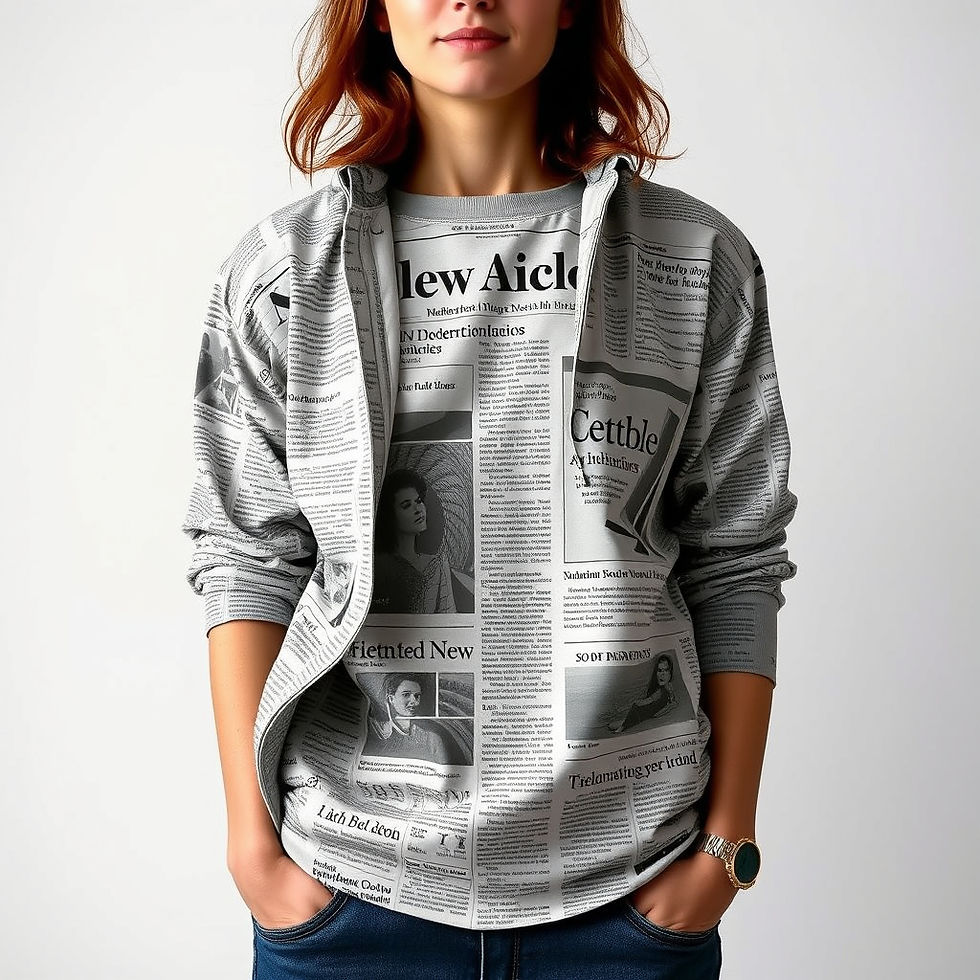
This summer, Desigual is bringing the newspaper back into the wardrobe. The Barcelona-born company has revisited one of its own archival graphic motifs, covering dresses, shirts, skirts, trousers, tops and handbags with typography inspired by the visual language of the printed press. The obvious cultural reference is impossible to miss. More than a quarter of a century after Carrie Bradshaw walked through Sex and the City in John Galliano's newspaper-print Dior dress, fashion is once again asking women to wear the headlines.

But there is a more interesting question than whether newspaper print is “back.” Why does fashion keep bringing it back at all? For anyone who watched Sex and the City around the turn of the millennium, the dress is difficult to separate from Carrie Bradshaw. She wore the John Galliano for Christian Dior design in Season 3, Episode 17, “What Goes Around Comes Around,” during the painfully memorable scene in which Carrie confronts Natasha, the wife of Mr. Big, to apologize for the affair that helped destroy their marriage. The scene was emotionally uncomfortable. The dress was unforgettable.
It was a remarkable collision of costume and character. Carrie, a newspaper columnist whose private life supplied much of the material for her writing, was literally dressed in newsprint while attempting to rewrite the consequences of her own story. Whether the symbolism was deliberate or simply a brilliant costume choice hardly matters anymore. The image entered fashion history.
Carrie later wore the Dior dress again in the second Sex and the City film, and its cultural afterlife has proved unusually durable. Sarah Jessica Parker has repeatedly revisited the visual language associated with it. Kim Kardashian wore vintage Dior newspaper print in 2019. Emily Ratajkowski has adopted contemporary versions of the motif. In 2023, designer Claire Sullivan created a new newspaper dress for Parker using material inspired by the actress's own Vogue covers and articles. Then, in May 2025, Jenna Ortega appeared at the New York premiere of Hurry Up Tomorrow wearing the archival Dior newspaper-print dress itself.
At that point, the question becomes unavoidable: are we looking at nostalgia, or has this become something closer to fashion mythology? Carrie's dress, after all, was never really the beginning.
Decades before Sex and the City, and decades before Galliano arrived at Dior, Elsa Schiaparelli was already turning the press into clothing. In 1935, the Italian-born Paris couturière created a textile printed with newspaper clippings about herself. The design appeared in her Stop, Look and Listen collection and was used across clothing and accessories. The Victoria and Albert Museum describes how Schiaparelli capitalized on the extraordinary press attention surrounding her career and personal life by transforming that coverage into fabric. It was fashion as self-publication. And it was extraordinarily modern.
Long before Instagram, influencers or designers building personal brands through social media, Schiaparelli understood that attention itself possessed value. The newspapers wrote about her; she took those newspapers and put them onto clothes; the clothes generated more attention; the attention generated more press. She had effectively created a fashion-media feedback loop in 1935.
John Galliano would return to the idea decades later. His newspaper imagery for Dior at the turn of the millennium drew upon that history, eventually producing the dress that television would transform into a pop-cultural artifact. The print was part of a controversial period in Galliano's work at Dior, making its later romanticization more complicated than the effortless glamour with which it is now often remembered. Fashion has a tendency to edit its own past. A provocative runway moment becomes a vintage collectible; controversy fades; the photograph survives.
That raises another question worth considering: when fashion revives an image, does it revive its history too; or merely its appearance? Desigual's 2026 interpretation is not a reproduction of Dior's print. The company is returning to its own newspaper motif, incorporating the Desigual name and graphic references to moments in the brand's history. According to the company, the pattern belongs to its creative archive and has now been reworked into contemporary silhouettes.
The central piece is a lightweight sleeveless white midi dress covered in newspaper-style graphics, but the motif extends considerably further. Desigual has developed white and black dresses, printed T-shirts, asymmetrical tops, mini and midi skirts, relaxed shirts and wide-leg trousers. Newspaper-print handbags offer a less committed way into the idea for someone who may not wish to walk down the street resembling the front page.
It is clever because the collection operates on several levels simultaneously. To a younger customer, it can simply look graphic and irreverent. To a millennial, it may immediately evoke Carrie Bradshaw. To someone familiar with Desigual's history, it represents the revival of a house motif. And to anyone interested in fashion history, it inadvertently participates in a visual conversation stretching back at least to Schiaparelli.
This is how fashion memory works. A new generation rarely inherits a reference exactly as the previous generation understood it. It receives an image, removes some of its original context and gives it another life.
That process has accelerated dramatically in the digital era. A teenager discovering Carrie Bradshaw today does not have to experience Sex and the City as viewers did when episodes originally aired. She can encounter the newspaper dress first through TikTok, Instagram, a vintage resale platform or a photograph of Jenna Ortega. The reference may arrive before the story.
This has helped turn early-2000s fashion into an enormous archive available for constant excavation. What was recently considered dated can become desirable almost overnight. Low-rise trousers, baguette bags, slip dresses and other signatures of the Y2K wardrobe have returned not because an entire generation collectively decided to reproduce the year 2000, but because digital culture has collapsed the distance between fashion eras. Everything is available at once.
Perhaps that is why calling such revivals “trends” no longer feels entirely adequate. Fashion once moved in relatively legible cycles. A runway introduced an idea, magazines interpreted it, retailers distributed it, consumers adopted it, and eventually everyone moved on. Today, a runway image from 2000 can suddenly circulate beside a new collection from 2026 and an original Schiaparelli textile from 1935. Past and present occupy the same screen.
The newspaper print is particularly suited to this strange collision of eras because the newspaper itself has changed so profoundly. In Schiaparelli's world, print newspapers were among the principal engines of mass information and cultural authority. In Carrie's fictional New York, being a newspaper columnist still carried a particular kind of urban glamour. Carrie sat at her laptop writing about relationships, but her words ultimately belonged to a physical column; the kind of writing readers could fold, carry onto the subway and perhaps spill coffee over.
Today, many people wearing a newspaper-print dress may rarely buy a printed newspaper. That gives the motif an unexpected new meaning. The newspaper is becoming aesthetic at precisely the moment when our relationship with printed news has become increasingly fragile. Typography, columns, headlines and black-and-white pages have acquired a kind of analogue romance. What was once ordinary information delivery now carries visual nostalgia.
We may therefore be witnessing something stranger than a Carrie Bradshaw revival: the transformation of the newspaper itself into a vintage cultural symbol. There is an irony here that Carrie might have appreciated. At a time when news travels through phones within seconds, fashion asks us to slow it down, print it onto fabric and wear it on our bodies. A headline that would disappear from a social-media feed in hours can become part of a dress preserved for decades.
Which medium, then, is more ephemeral? The newspaper or the fashion? History suggests that the answer is not as obvious as it seems. A newspaper is created to record the present but is usually discarded tomorrow. Fashion is routinely dismissed as temporary, yet certain garments survive for generations. Museums preserve them. Collectors hunt for them. Designers quote them. Television gives them personalities. Eventually, an old dress can tell us as much about an era's aspirations, anxieties and ideas of femininity as the headlines printed on its surface.
Carrie Bradshaw's Dior dress survived because it was more than attractive. It became attached to a character who changed the way television represented fashion. Her wardrobe was not merely decoration. It communicated ambition, insecurity, sexuality, financial recklessness, fantasy and the determination to construct an identity through clothes. Carrie frequently made questionable decisions, but she rarely dressed apologetically.
That distinction helps explain why her wardrobe continues to resonate. The enduring fascination with Carrie is not really about copying her outfits piece by piece. Most people do not need her impossible heels, enormous flower corsages or financial relationship with Manolo Blahnik. What remains compelling is the permission her clothes seemed to offer: the idea that dressing could be personal, eccentric, contradictory and occasionally ridiculous without requiring an apology.
Desigual has long built its identity around a similar proposition of visual individuality. Founded in Barcelona in 1984, the brand became known for pattern, color, patchwork and an exuberance often at odds with fashion's periodic devotion to minimalism. Its decision to retrieve newspaper print from its archive therefore makes sense beyond the commercial usefulness of the Carrie connection.
But it also reveals something about fashion in 2026. Brands increasingly understand that their archives are not dusty storage rooms; they are intellectual and commercial assets. Heritage can be repackaged for audiences too young to remember the original. A pattern returns, a silhouette changes, an old photograph circulates, and suddenly history becomes new inventory.
There is nothing inherently cynical about this. Fashion has always borrowed from itself. Indeed, some of its most interesting moments emerge when designers reinterpret rather than invent from nothing. But the best revivals do more than reproduce a recognizable surface. They invite us to reconsider why the original mattered.
And the newspaper print matters because it sits at an unusually rich intersection of fashion, media, celebrity and memory. Schiaparelli turned her press coverage into clothing. Galliano transformed newsprint into runway provocation. Carrie Bradshaw turned it into television mythology. Celebrities and designers kept the image circulating. Now Desigual introduces its own archival version to another generation. The words change. The woman wearing them changes. The medium through which we discover her changes. Yet the fascination remains.
Perhaps that is because clothing and newspapers have always shared a fundamental purpose. Both tell us something about the moment in which they were created. One announces what happened today; the other reveals how we wanted to be seen while it was happening. Years later, both become evidence.
So yes, newspaper print is making headlines again. But the more interesting story is not that fashion has rediscovered Carrie Bradshaw. It is that fashion continues to rediscover itself; and that each generation seems convinced, for a little while, that the old story it has just found is entirely new. The newspaper dress knows better.
Sources:
Desigual official website — background on the Barcelona fashion house; the July 30, 2026 press release supplied to French Quarter Magazine was also used for details of the new capsule and its archival Desigual motif.
V&A — Schiaparelli: Fashion Becomes Art — museum documentation of Elsa Schiaparelli's 1935 newspaper-cutting textile, its use in the Stop, Look and Listen collection and her incorporation of her own press coverage into fashion.
Vogue — A Brief Visual History of Fashion's Obsession with Newspapers — historical overview tracing newspaper fashion from Schiaparelli through Galliano and contemporary designers.
Vogue — Carrie Bradshaw's Most Memorable Looks — identification of the Dior Fall 2000 newspaper dress, its runway origins and Carrie's appearance in Season 3, Episode 17 of Sex and the City.
Vogue — Claire Sullivan Reworks Carrie's Newspaper Dress — Sarah Jessica Parker's 2023 reinterpretation using imagery and stories from her Vogue history.
Vogue — Jenna Ortega Channels Carrie Bradshaw — Ortega's May 2025 appearance in the archival Galliano-era Dior newspaper dress and the motif's continuing presence in contemporary fashion.
Harper's Bazaar — Emily Ratajkowski Channels Carrie Bradshaw — documentation of the newspaper motif's continuing reinterpretation beyond Dior.
Header Photo: www.desigual.com


Comments