
The Pharaohs Built for Eternity. What Actually Survived?
Updated: Aug 18
There is something almost irresistible about the word treasure. It promises gold, rarity, discovery; the intoxicating possibility that somewhere beneath centuries of dust, history has been waiting for us to find it. At San Francisco’s de Young museum, Treasures of the Pharaohs certainly delivers that spectacle. On view from August 1, 2026, through January 31, 2027, the exhibition brings together 130 objects spanning some 3,000 years of ancient Egyptian civilization, from monumental sculpture to extraordinarily delicate jewelry. Many have rarely traveled, and a particularly important group of objects is making its North American debut.

But perhaps the most interesting question raised by this exhibition is not what the pharaohs possessed. It is what their possessions can still tell us about the people who lived beneath them. Ancient Egypt has suffered, rather magnificently, from its own success. Few civilizations have created a visual language so powerful that it remains instantly recognizable thousands of years later. A profile beneath an elaborate headdress, a falcon, a scarab, a hieroglyph, the gleam of gold, and we know where we are. Egypt has become simultaneously a historical civilization and an idea in the modern imagination. That familiarity can be deceptive. We know Tutankhamun's mask. We know pyramids and mummies. We know the names of Cleopatra, Ramses and Nefertiti. But how well do we understand the civilization that produced them? And what happens when we stop looking at ancient Egypt primarily through the people who ruled it?

That is where Treasures of the Pharaohs becomes more interesting than its seductive title initially suggests. The exhibition begins, appropriately, with power. In pharaonic Egypt, the king was not merely a political administrator occupying the highest office in the land. Kingship existed within a sacred order. The pharaoh stood between the human and divine worlds, and the astonishing objects created around him helped make that authority visible. One of the exhibition's opening works makes the point with remarkable economy: an Old Kingdom triad depicting Pharaoh Menkaure alongside the goddess Hathor and a personification of a province of Egypt. The ruler appears naturally in the company of gods. This was art, but it was also something more complicated. It was theology. It was politics. It was an assertion about how the universe itself was organized. And that invites an unexpectedly contemporary question: when does beauty become an instrument of authority?
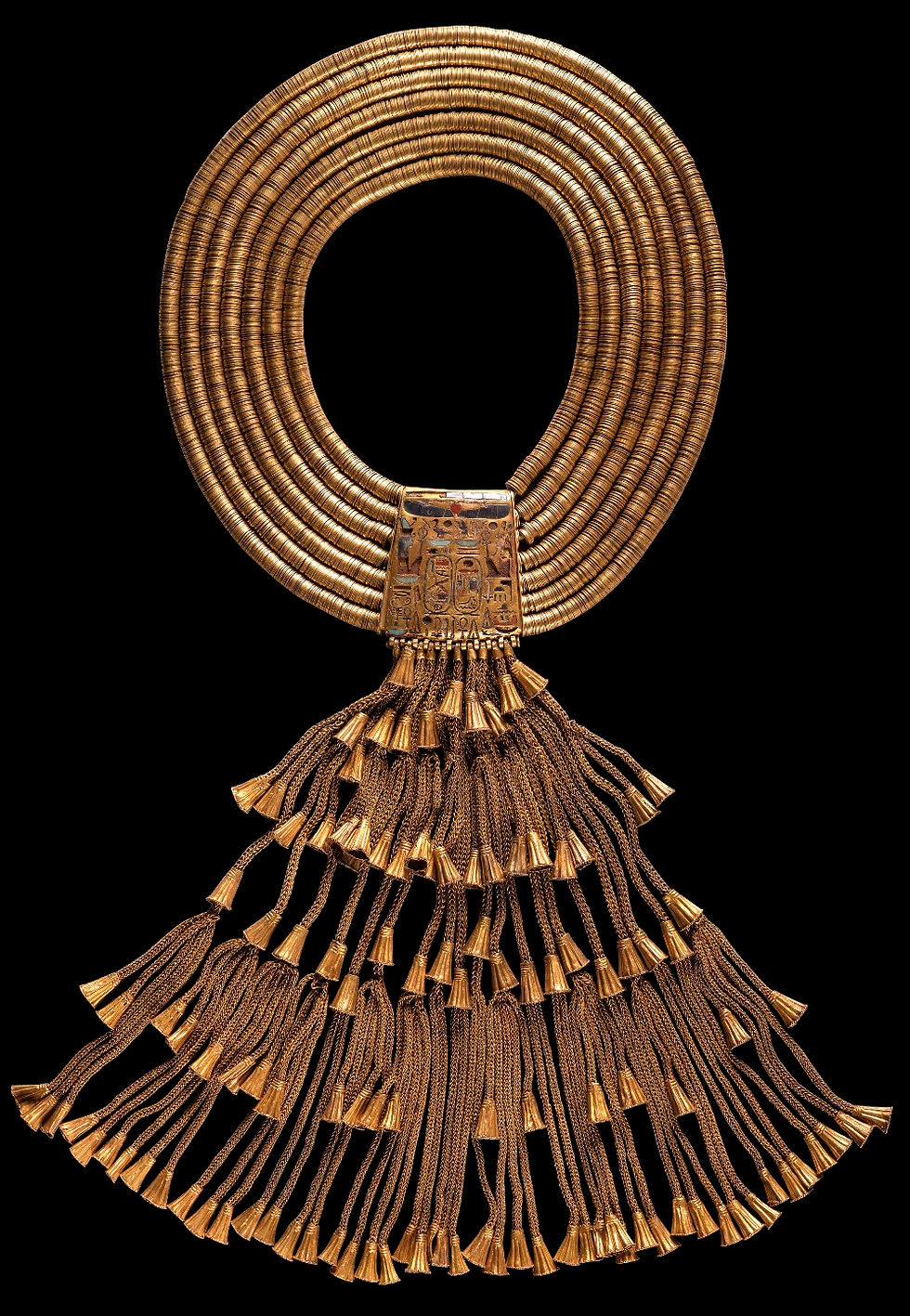
The Egyptians understood something every powerful civilization since has rediscovered; that power becomes considerably more durable when it is transformed into architecture, ceremony, symbolism and memory. Gold therefore matters here, but not merely because it was expensive. The exhibition includes exquisite royal objects and jewelry associated with rulers and their families, including a bracelet of gold and lapis lazuli belonging to Pharaoh Psusennes I. Such objects demonstrate astonishing technical mastery, but they also speak a language of permanence. Gold does not tarnish. For a civilization preoccupied with continuity beyond death, its physical properties carried meaning.
Yet the further one travels through the exhibition, the less satisfying it becomes to think of ancient Egypt simply as a succession of glamorous rulers surrounded by precious objects. Because someone mined the stone, hammered the gold and carved the hieroglyphs. Someone baked the bread, constructed the tombs and raised the royal children. Someone made the objects we now place behind museum glass. And remarkably, archaeology is beginning to allow some of those people back into the story.
Among the exhibition's most compelling inclusions are approximately 20 objects from the settlement popularly known as the Golden City, discovered on Luxor's west bank in 2021 and associated with the reign of Amenhotep III in the 14th century BC. These objects are being shown in North America for the first time. The remarkably preserved settlement, with its houses, workshops, streets and evidence of ordinary activity, has invited comparisons with Pompeii because of the unusual immediacy with which it preserves daily life. Here the drama changes. A royal necklace tells us how a queen presented herself. A workshop tells us how a society functioned.

Among the discoveries from the settlement are traces of brickmaking, domestic life, worship and family activity. Something as modest as a baby's rattle suddenly assumes enormous emotional power. So does a limestone headrest, an everyday object designed in part to protect a sleeping person from insects. A baby's rattle beside the treasures of kings: it is difficult to imagine a better correction to our instinctive understanding of history. For what survives from antiquity has always shaped what we believe antiquity was. Palaces endure more readily than kitchens. Royal inscriptions proclaim victories while ordinary people rarely commission monuments describing an uneventful Tuesday. Museums themselves inherited collecting traditions that privileged exceptional objects; the rarest gold, the finest sculpture, the possessions of rulers. But civilization did not happen only in palaces. It happened while people cooked meals, raised children, manufactured bricks, worried about illness, worshipped gods, fell in love, worked, slept and prepared for tomorrow.
That realization gives the exhibition's funerary material another dimension. The Egyptian relationship with death has fascinated outsiders for centuries, sometimes to the point of caricature. Mummies, tombs and elaborate preparations for the afterlife can make ancient Egyptians appear obsessed with dying. But were they? Or were they extraordinarily attached to living? The distinction matters. Objects placed in tombs included jewelry, cosmetics, furniture, tools and other things associated with earthly existence. Perhaps the tomb was therefore not simply a monument to death. Perhaps it was an argument that the pleasures, identities, relationships and comforts of life were too important to surrender.
The exhibition encourages visitors to look beyond glittering surfaces and consider whether extraordinary craftsmanship has sometimes obscured the human stories behind these objects. Why did pharaohs bury so much wealth with the dead? Should we really interpret that practice as evidence that they spent their lives preparing to die? Or could their elaborate preparations for eternity reveal precisely how much they valued existence itself? That question opens another, more uncomfortable one: what do we bury with ourselves today? Not literally, perhaps. But civilizations are always choosing what they hope will survive them; buildings, photographs, monuments, archives, works of art, digital records, names on institutions and carefully constructed stories about themselves.
The pharaohs attempted immortality on an almost unimaginable scale, and in one sense, they succeeded. We still speak their names. Yet history has played a subtle trick on them. The kings commissioned monuments to preserve their greatness, but thousands of years later archaeology increasingly directs our curiosity toward the anonymous men and women surrounding them. Who painted this? Who wore that? Who built this house? Who held that child's rattle? The very people who were supposed to remain in the background are slowly stepping forward.

The exhibition also reminds us that ancient Egypt was not culturally frozen during its three millennia of pharaonic history. Beliefs changed. Political structures evolved. Artistic conventions were challenged. One extraordinary limestone relief depicts Akhenaten with members of his family worshipping Aten, the solar deity elevated during the pharaoh's radical religious transformation. Seen against the much earlier image of Menkaure comfortably embedded within the traditional divine order, it reveals something easy to forget: even civilizations we now perceive as ancient traditions once experienced disruptive new ideas. Every tradition was once contemporary. Every monument was once new. Every ancient controversy once unfolded in the present tense.
That may be the exhibition's most useful lesson. Museums can tempt us to imagine history as finished. Objects sit silently beneath controlled lighting, dates neatly printed beside them. A civilization that was once noisy, political, uncertain and alive becomes orderly. But ancient Egypt was never an exhibition. It was millions of human lives unfolding without knowledge of what came next. Its people could not have known that visitors in San Francisco would one day stand before their belongings. They could not know that their civilization would become one of humanity's great symbols of antiquity, or that objects created for temples, homes and tombs would eventually travel across oceans.
There is something worth contemplating in that journey itself. Objects created thousands of years before the modern nation-state now travel internationally as ambassadors of Egyptian civilization. Archaeology becomes cultural diplomacy. Museums become meeting places between societies separated not merely by geography, but by millennia. And audiences continue to come. Why?

Perhaps because ancient Egypt confronts us with the contradiction at the center of human civilization: everything passes, yet human beings continually create as though something might remain. The pharaohs built for eternity. Their kingdoms disappeared. Their language fell silent for centuries. Their temples became ruins. And still, remarkably, something survived. Gold survived. Stone survived. A child's rattle survived.
But the greatest treasure may be neither gold nor granite. It may be the sudden recognition, across 3,000 years, that the people who made these objects were not abstractions called “the ancient Egyptians.” They were individuals living inside their own present, surrounded by ambitions, beliefs, families, fears and questions they could not answer, much like us. And perhaps that is why we continue looking through museum glass into their world. We are not merely trying to understand what happened to them. Somewhere beneath the gold, we are asking what will remain of us?
Header Photo Credits: Installation view of "Treasures of the Pharaohs," de Young museum, San Francisco, 2026. Photography by Gary Sexton


Comments