
The New Riviera: Discovering France's Most Sophisticated Mediterranean Escape

Updated: 5 days ago
There was a time when the French Riviera represented a single idea. People came for the sunshine. They arrived aboard elegant ocean liners, traveled by train from Paris, London, or Milan, and spent long afternoons strolling palm-lined promenades before gathering inside Belle Époque hotels where royalty, aristocrats, artists, and industrialists quietly shaped the social calendar of Europe. Luxury was measured by grand hotels, formal dinners, impeccable service, and the simple privilege of wintering beneath the Mediterranean sun.
The Côte d'Azur still offers all of that. But today's Riviera tells a different story. Luxury is no longer defined solely by marble lobbies, Michelin stars, or the length of a yacht anchored in Monaco's Port Hercule. Increasingly, travelers seek something less visible and infinitely more valuable: authenticity, craftsmanship, privacy, cultural immersion, exceptional gastronomy, wellness, sustainability, and experiences that cannot simply be purchased.
From Monte-Carlo to Saint-Tropez, the French Mediterranean coast is quietly reinventing itself, blending its legendary glamour with a new generation of hotels, beach clubs, restaurants, museums, vineyards, and cultural experiences that reward curiosity as much as elegance.
For readers of French Quarter Magazine, this transformation makes the Riviera more fascinating than ever. Behind its famous beaches and postcard harbors lies one of Europe’s richest cultural landscapes; a place where old rituals of Mediterranean elegance are being reinterpreted through architecture, gastronomy, music, art, and a decidedly more experiential idea of luxury.
Monte-Carlo: Where Luxury Continues to Reinvent Itself
No address better illustrates the Riviera’s enduring ability to reinvent itself than Place du Casino in Monte-Carlo. Developed during the nineteenth century under the influence of the Société des Bains de Mer, the district helped transform a small Mediterranean principality into an international destination built not simply around gaming, but around architecture, hospitality, opera, gastronomy, gardens, wellness, and spectacle.
Today, the square remains one of Europe’s most elegant urban stages.

The beautifully restored Hôtel de Paris Monte-Carlo continues to embody Riviera hospitality, balancing Belle Époque grandeur with contemporary luxury. Across the square, the legendary Casino de Monte-Carlo welcomes visitors into interiors whose gilded ornamentation and theatrical proportions have helped shape Monaco’s mythology for generations.
But Monte-Carlo’s most compelling luxury may no longer be something one possesses.
It is access: to a place, a moment, a view, a table, an atmosphere that exists nowhere else.
Begin early, before the square fills. Watch the first Mediterranean light move across its façades, then descend toward Port Hercule, where Monaco slowly awakens among sailing boats and superyachts. Continue toward the principality’s cultural landmarks, from the Grimaldi Forum to the extraordinary Oceanographic Museum of Monaco, seemingly suspended above the Mediterranean.
And then, as daylight begins to soften, Monte-Carlo reveals another personality.
Inside Amazónico: A Tropical World Above Monte-Carlo
One of the most unexpected expressions of this new Monaco can be found at Amazónico Monte-Carlo, where dining has been transformed into something closer to theatre.
This summer, Karla, FQM’s brand-new correspondent, stepped inside Amazónico for French Quarter Magazine, giving us a glimpse of an address that seems deliberately designed to make visitors temporarily forget where they are.
Follow Karla’s Riviera discoveries on Instagram at @Frenchgirlfortrump.

Ascending to Amazónico’s rooftop feels almost like crossing an invisible border. The polished geometry of Monte-Carlo gives way to abundant foliage, exotic textures, sumptuous seating and a distinctly tropical sensibility. Yet the Mediterranean is never truly absent. From the roof terrace, the view opens over Monaco’s celebrated Golden Square, creating an extraordinary juxtaposition: tropical fantasy suspended above one of Europe’s most sophisticated urban landscapes. During the Monaco Grand Prix, the terrace even becomes a privileged vantage point from which guests can watch the spectacle below.
But what makes Amazónico particularly interesting is that the experience does not stop with the plate. As evening settles over Monaco, the restaurant begins to change rhythm. Jazz, Bossa Nova and Cuban sounds from live Latin musicians move through the space, while elsewhere the Bar & Lounge shifts into a more electric register. Resident and guest DJs introduce the restaurant’s signature “elec-tropical” sound, a fusion of electronic music and Latin influences, occasionally joined by international drummers, trumpeters and other performers. Guests can dine from the à la carte menu in the lounge while cocktails and music carry the evening forward.
There is something wonderfully improbable about it: a jungle-inspired rooftop above Monte-Carlo, champagne at sunset, Latin rhythms drifting into the Mediterranean night, and the architectural grandeur of Monaco glowing beyond the leaves.
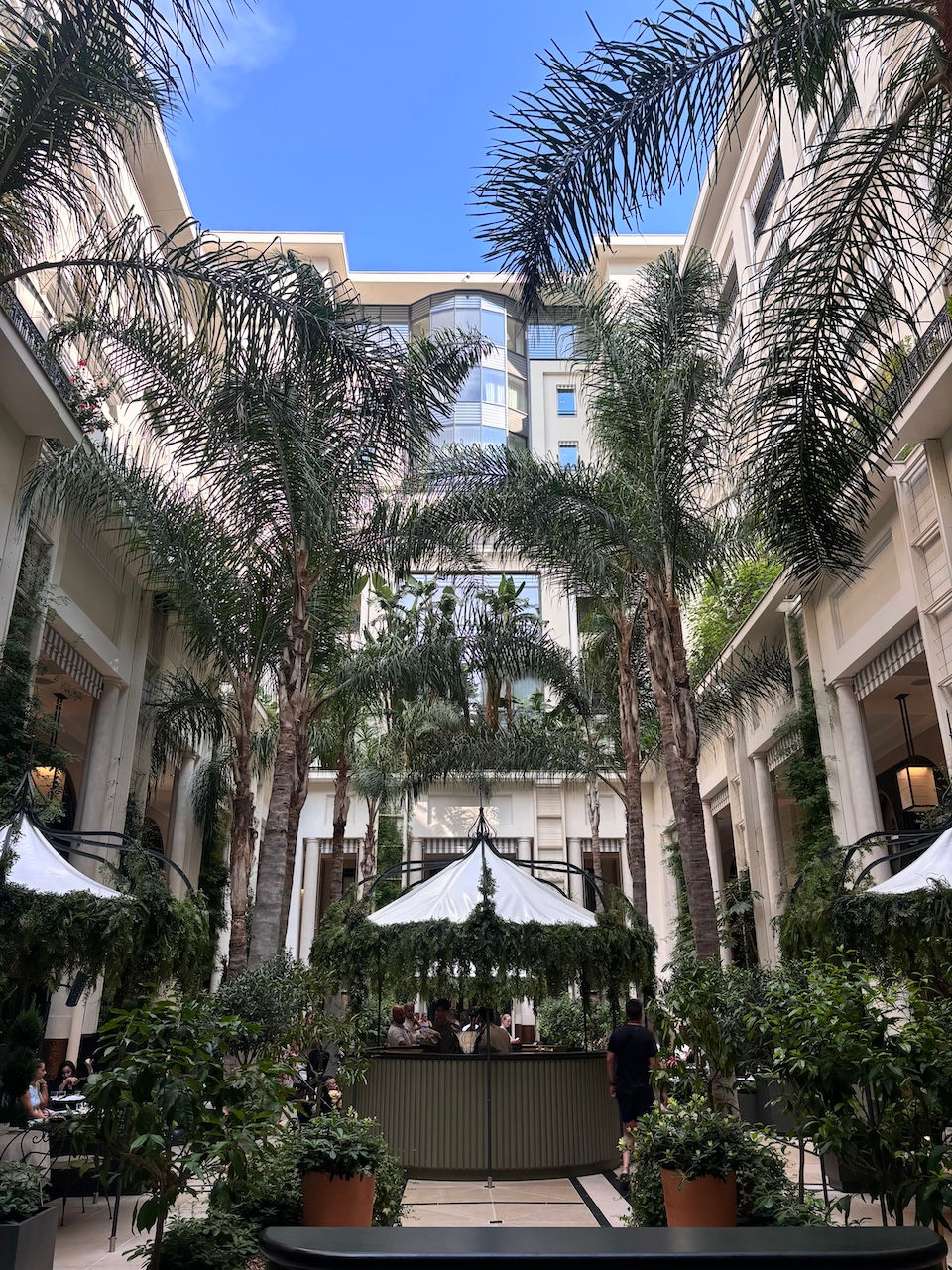
The rooftop also contains more intimate worlds within it, including a private dining terrace accommodating up to 30 guests and a separate cigar terrace.
Amazónico therefore represents something larger than another fashionable restaurant opening. It captures a shift occurring across the Riviera itself.
The Côte d’Azur has always understood spectacle. What is changing is the nature of that spectacle. The new luxury is increasingly immersive: not simply where you stay or what you order, but what you see from your table, what music surrounds you, who you encounter, and the story you remember afterward.
For Karla’s first explorations as FQM’s correspondent in Monte-Carlo, Amazónico could hardly provide a more fitting introduction.
Because this is precisely the Riviera French Quarter Magazine wants to uncover; not simply the places everyone photographs, but the experiences hidden behind the façades: the extraordinary table, the unexpected terrace, the cultural encounter, the view that suddenly explains why generations of artists, writers, royalty and travelers have been unable to resist this small stretch of Mediterranean coast.
Monte-Carlo has never stopped being glamorous. What is changing is what glamour means. And perhaps that is the real story of the new Riviera.
Saint-Jean-Cap-Ferrat: The Riviera's Quiet Masterpiece
Just twenty minutes east of Nice lies a peninsula that has captivated kings, artists, financiers, and writers for more than a century. Unlike the spectacle of Monaco or the celebrity culture of Saint-Tropez, Saint-Jean-Cap-Ferrat whispers rather than announces its elegance.
Its winding coastal paths reveal hidden coves, pine forests, Belle Époque villas, and breathtaking Mediterranean views around nearly every corner.
The iconic Grand-Hôtel du Cap-Ferrat, A Four Seasons Hotel remains one of the Riviera's most celebrated palace hotels. Since opening in 1908, it has welcomed monarchs, diplomats, writers, artists, and generations of travelers seeking tranquility without sacrificing refinement.


Just minutes away, the magnificent Villa Ephrussi de Rothschild offers one of the Riviera's greatest cultural experiences. Built by Baroness Béatrice de Rothschild, the pink villa overlooks the Mediterranean from gardens inspired by France, Italy, Spain, Japan, and Provence. Every terrace tells a different story of landscape design, architecture, collecting, and aristocratic life during the Belle Époque.
Few visitors leave without wondering why they had never heard more about it.
The Riviera Beyond the Beach
The modern Riviera is rediscovering its cultural identity. Travelers increasingly divide their days between museums, gardens, historic villages, vineyards, contemporary art, sailing excursions, perfume workshops, and coastal walks.
The spectacular cliffside village of Èze remains one of the region's most unforgettable destinations. Perched hundreds of meters above the Mediterranean, its medieval streets, artisan boutiques, and panoramic views remind visitors that the Riviera's history extends far beyond luxury tourism.
Nearby, the renowned Fragonard Perfume Factory invites visitors to discover one of France's oldest artistic traditions. Guided tours reveal the history of perfume-making before concluding with workshops where guests may create their own fragrance.
This is today's Riviera. Not simply a destination to admire. A destination to experience.
Where Culture Meets the Sea
If Monte-Carlo represents the Riviera's elegance, Cannes embodies its international stage.
For many travelers, Cannes begins and ends with the Film Festival. Each May, celebrities, filmmakers, and photographers transform the Croisette into one of the world's most recognizable red carpets. Yet beyond the flashes of cameras lies a city whose cultural life extends throughout the year.
Morning offers the Riviera at its most peaceful. Walk the Boulevard de la Croisette before the cafés fill, watching fishermen return to the harbor as the Mediterranean reflects the first light of the day. Continue toward the iconic Carlton Cannes, a Regent Hotel, whose Belle Époque silhouette has welcomed royalty, film stars, artists, and writers since 1913.
Just steps away stands the Palais des Festivals et des Congrès, famous for the Festival de Cannes but equally active throughout the year with exhibitions, concerts, international conferences, and cultural events.
The secret to experiencing Cannes, however, is to leave the Croisette for a few hours. The old quarter of Le Suquet, with its narrow medieval streets, small galleries, local restaurants, and panoramic views over the Bay of Cannes, reminds visitors that this glamorous resort was once a quiet Provençal fishing village.
Luxury, here, coexists with authenticity.
Antibes: Where Picasso Found Inspiration
Few places illustrate the Riviera's artistic legacy better than Antibes.
Sheltered by sixteenth-century ramparts and overlooking one of the Mediterranean's oldest ports, the city has inspired painters, sculptors, photographers, and writers for generations.
The centerpiece is the remarkable Musée Picasso. Housed inside the Château Grimaldi, where Pablo Picasso worked in 1946, the museum preserves paintings, drawings, ceramics, and sculptures donated by the artist himself. Standing inside the studio where Picasso overlooked the sea, visitors quickly understand why the Côte d'Azur became one of the twentieth century's greatest artistic laboratories.
Just beyond the historic center lies Port Vauban, Europe's largest marina, where sleek superyachts share the harbor with traditional Provençal fishing boats.
It is an image that perfectly captures the new Riviera. History and modernity coexist without competing.
Saint-Tropez Beyond the Myth
No destination on the French Riviera may be more misunderstood than Saint-Tropez. To much of the world, it is a shorthand for celebrity, superyachts and champagne-soaked summers. Yet beyond the mythology lies something far more compelling: an old Provençal port surrounded by vineyards, Mediterranean forest, hidden coves and villages where the rhythms of the land remain remarkably present.
Long before Brigitte Bardot helped transform Saint-Tropez into an international emblem of freedom and glamour in the 1950s, this was a maritime community whose narrow streets and harbor still carry traces of an earlier Mediterranean life.
The best way to understand it is to arrive early.
Before the boutiques open and the terraces fill, the old port belongs to fishermen, café owners and early risers. Walk upward toward the Citadelle de Saint-Tropez, where the Maritime History Museum recounts the town’s centuries-long relationship with the sea, then return toward Place des Lices, where the Provençal market provides a very different portrait of Saint-Tropez; one of olives, cheeses, fruit, flowers, linens, baskets and conversations beneath the plane trees.
But to discover another side of the peninsula, leave Saint-Tropez behind for a few hours.
Drive toward La Croix-Valmer, where the Mediterranean landscape begins to reveal one of its oldest secrets.
Where the Riviera Becomes a Vineyard: Domaine de La Croix
Here, between the Mediterranean Sea and the Massif des Maures, lies the remarkable Domaine de La Croix, a historic Cru Classé Côtes de Provence estate surrounded by the luminous landscapes of the Saint-Tropez peninsula. Its location gives the vineyards a distinctive microclimate, with the sea and surrounding terrain contributing to the character of its terroir.

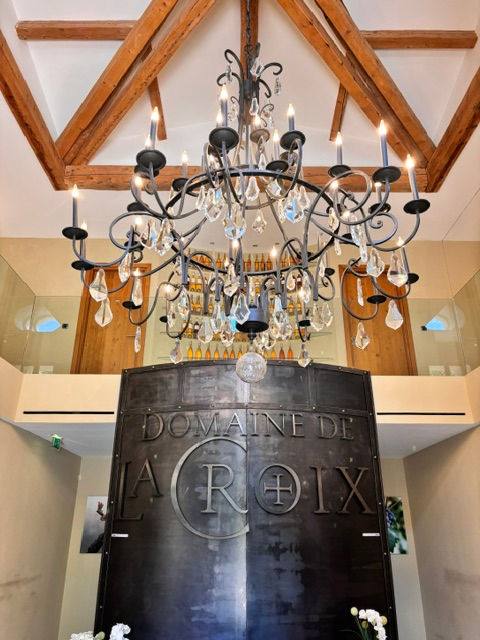
It was here that Karla ventured beyond the familiar Saint-Tropez addresses to explore the estate for French Quarter Magazine. Readers can also follow her discoveries on Instagram at @Frenchgirlfortrump.
What she found is more than a beautiful vineyard.

Domaine de La Croix is intertwined with the birth of La Croix-Valmer itself.
Its story reaches back to 1882, when Albert de Vrégille, a former military man with a passion for wine, acquired some 230 hectares and envisioned something unusually ambitious: not merely a vineyard, but a wine-producing and tourism estate. Within a decade, approximately 100 hectares were under vine, while roads, farms, a chapel, villas, housing and shops appeared around the property. In a very real sense, the estate helped create the community that eventually became La Croix-Valmer.
That history makes arriving here feel different.
You are not simply entering a winery. You are entering a landscape that helped shape an entire corner of the Riviera.
The Domaine subsequently experienced periods of glory and decline before undergoing a major revival after its acquisition in 2001. Vineyards were replanted, underground cellars created and winemaking facilities modernized. Today, its approximately 108 hectares of vines make it the largest of the estates recognized as Crus Classés Côtes de Provence since 1955, according to Oenotourisme.

And this is where the Riviera becomes wonderfully sensory.
Imagine leaving the crowded harbor of Saint-Tropez and, not long afterward, finding yourself among rows of vines with the Mediterranean nearby and the Massif des Maures rising behind you. The air changes. The pace changes. The landscape seems to ask you to slow down.
At Domaine de La Croix, visitors can discover the wines, meet the team and explore the surrounding Mediterranean scenery; guided cellar visits are also offered by reservation.
The experience also reveals something that is too easily forgotten about the Côte d’Azur: rosé is not simply a summer accessory here. It is part of a serious agricultural and cultural heritage.
These vineyards are expressions of place of Mediterranean sun, maritime influence, soil, cultivation and generations of knowledge. The estate produces rosé, white and red wines under the Côtes de Provence appellation, continuing a wine story whose roots stretch back nearly a century and a half. There is another contemporary dimension worth noticing. Domaine de La Croix holds France's Haute Valeur Environnementale certification, reflecting agricultural practices attentive to biodiversity and environmental considerations.
For travelers, this makes the Domaine especially interesting because it offers something Saint-Tropez's most glamorous addresses cannot reproduce: a connection between what is in the glass and the landscape visible beyond it.
A tasting here becomes a lesson in geography.
The vines, the hills, the sea air and the Provençal vegetation are no longer scenery. They become part of the story.
And perhaps that is the extraordinary discovery Karla brings back to FQM readers from this corner of the peninsula.
The real luxury of Saint-Tropez may begin precisely where the mythology ends.
It is leaving the yacht harbor behind. Turning inland. Following the road through Provence. Walking between vines. Discovering that one of the Riviera's most beautiful experiences is not about being seen at all, but about learning to see.
For French Quarter Magazine, Domaine de La Croix represents exactly the New Riviera we want to explore: places where heritage and contemporary elegance coexist, where a beautiful setting carries a deeper history, and where luxury is measured not only by exclusivity but by authenticity, knowledge and connection to place.
Saint-Tropez will always have its yachts, its beach clubs and its famous names.
But beyond them is another Riviera; one of vineyards, terroir, history and Mediterranean silence.
And that Riviera may be the one worth remembering longest.
The New Beach Club Culture
The beach club has become one of the defining symbols of the modern Riviera. Yet today's finest establishments offer far more than comfortable sun loungers. They have become destinations where gastronomy, design, music, wellness, and hospitality merge into a single experience.

Among our favorites is Club La Vigie Monte-Carlo, perched dramatically above the Mediterranean with panoramic coastal views. Near Cannes, Mademoiselle Gray Plage Barrière combines refined Mediterranean cuisine with one of the Riviera's most elegant beachfront settings.
In Saint-Tropez, the legendary beach clubs along Pampelonne Beach continue to reinvent themselves each season, blending contemporary design with relaxed Provençal elegance.
Reservations are essential. During July and August, the most desirable beach clubs frequently reach capacity several weeks in advance.
Dining Becomes the Destination
The Riviera's culinary landscape has evolved just as dramatically. Today, travelers increasingly organize entire itineraries around exceptional restaurants. Few names command greater respect than Mirazur, where Chef Mauro Colagreco transformed a hillside overlooking the Mediterranean into one of the world's most celebrated dining experiences.
Equally remarkable is Le Louis XV – Alain Ducasse à l'Hôtel de Paris, where Riviera ingredients meet one of French gastronomy's greatest culinary traditions.
These restaurants are no longer simply places to eat. They have become cultural institutions in their own right. Their menus tell the story of Mediterranean landscapes, local producers, fishing traditions, olive groves, vineyards, and seasonal rhythms that have shaped southern France for centuries.
For many travelers, a memorable dinner becomes as meaningful as a museum visit. Because both tell the story of a place.


Comments