
European Heritage Days 2026: The Secret Weekend When France Opens Its Palaces, Ministries and Hidden Treasures

Updated: 3 days ago
There are museums that preserve history. And then there are the places where history is still being written.
For one extraordinary weekend every September, France quietly opens the doors to both. Behind elegant iron gates, imposing ministries, presidential salons, diplomatic residences, military academies, private châteaux, forgotten archives, libraries, scientific laboratories, and historic hôtels particuliers, another France suddenly becomes accessible. These are not monuments admired only from the outside. They are living institutions where presidents receive heads of state, diplomats negotiate international agreements, judges interpret the law, conservators protect centuries of artistic heritage, and artisans continue traditions passed from one generation to the next.
For forty-eight remarkable hours, visitors are invited not simply to admire French history. They are invited to step inside it.
The challenge, however, is not deciding whether to participate; it is knowing where to begin. To help you make the most of this extraordinary event, French Quarter Magazine has written an article as a companion guide entitled "How to Plan Your "European Heritage Days" Weekend Like an Insider," featuring reservation strategies, practical tips, suggested itineraries, and insider recommendations.
Known as the Journées européennes du patrimoine—the European Heritage Days—this annual event has become one of France's most anticipated cultural weekends, attracting millions of visitors every year. Yet despite its extraordinary popularity within France, it remains one of Europe's best-kept secrets among international travelers. Those who know Paris only through the Louvre, Notre-Dame, or Versailles often have no idea that, for one unforgettable weekend, doors normally closed to everyone except presidents, ambassadors, ministers, judges, scholars, and civil servants are opened to the public. It is a uniquely French idea.
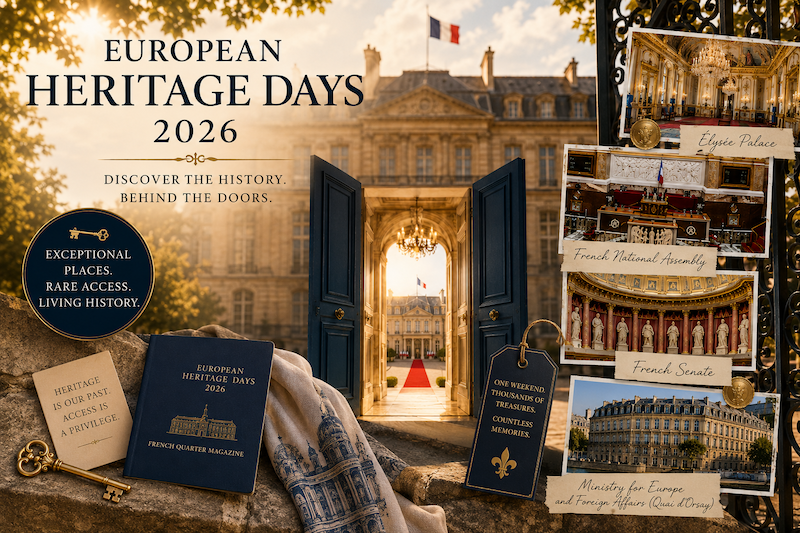
Rather than presenting heritage as something to be admired from behind velvet ropes, France invites its citizens; and increasingly visitors from around the world; to encounter the places where the Republic continues to live. The result is not simply a festival of architecture but a celebration of democracy, memory, craftsmanship, diplomacy, and public service.
The origins of this remarkable initiative date back to 1984, when Jack Lang, then France's Minister of Culture, launched what was originally called the "Open Doors Day for Historic Monuments." His proposal was revolutionary in its simplicity. Historic buildings maintained with public resources should occasionally be opened to the public itself. Heritage, he argued, should not belong exclusively to historians, architects, or government officials. It belonged to everyone.
The experiment exceeded every expectation.
Crowds gathered outside palaces, ministries, monasteries, and historic residences, eager to discover places they had passed countless times without ever entering. What began as a national initiative soon attracted international attention. In 1991, the Council of Europe embraced the French concept and expanded it across the continent, creating what we now know as the European Heritage Days. Today, nearly fifty countries participate each autumn, making it one of Europe's largest cultural events. Yet France remains its spiritual home.
Unlike many heritage festivals elsewhere in Europe, the French edition extends far beyond museums and castles. Ministries become classrooms. Presidential residences become civic landmarks. Diplomatic residences become places of cultural dialogue. Archives become living witnesses to the nation's collective memory. Scientific institutions reveal discoveries that transformed modern life. Military academies explain traditions that have shaped generations of officers. Historic workshops demonstrate crafts whose techniques have survived for centuries.
Few countries open so much of their institutional life to public curiosity. That philosophy reflects a much older French tradition.
Since the French Revolution transformed royal collections into national museums, France has defended the principle that culture belongs to the nation rather than to a privileged few. The opening of the Louvre in 1793 established an idea that continues to shape French cultural policy today: artistic masterpieces, historic buildings, archives, and public institutions should be shared whenever possible. The European Heritage Days represent perhaps the purest expression of that ideal.
Visitors do not merely discover magnificent interiors. They discover how a nation understands itself.
The timing of the 2026 edition carries particular significance. Across Europe, this year's theme, "Heritage at Risk: Revive, Resist, Reimagine", invites reflection on the growing challenges confronting cultural heritage. Climate change, flooding, wildfires, armed conflict, urban development, organized art theft, and the aging of historic buildings have transformed preservation into one of the defining cultural responsibilities of our century.
France understands these challenges all too well.
The devastating fire at Notre-Dame de Paris in April 2019 remains etched into the national memory. Millions watched as flames consumed one of the world's most celebrated cathedrals. Yet the extraordinary restoration that followed became a symbol not only of architectural expertise but also of collective determination. Engineers, historians, carpenters, stained-glass specialists, stone masons, conservators, archaeologists, and craftsmen united around a single objective: proving that heritage is never simply inherited; it must continually be protected.
That lesson now resonates throughout the European Heritage Days.
Behind every open monument stand thousands of professionals whose work rarely attracts headlines: conservators stabilizing fragile manuscripts, archivists preserving diplomatic correspondence, architects restoring medieval vaults, engineers monitoring structural movement, gardeners maintaining historic landscapes, librarians protecting rare collections, diplomats preserving centuries-old residences, and volunteers who dedicate their lives to safeguarding local history.
For one weekend, these usually invisible professions become part of the visitor experience. History is no longer confined to exhibitions. It becomes a conversation.
As European Heritage Days invites us to rediscover the buildings, traditions and treasures passed from one generation to the next, FQM turns to another remarkable form of inheritance: the unique patterns at our fingertips. Discover our article: Fingerprints: Some heritage, we carry with us! Formed before birth and carried throughout our lives, fingerprints reveal an extraordinary intersection of biology, identity and science.


Comments